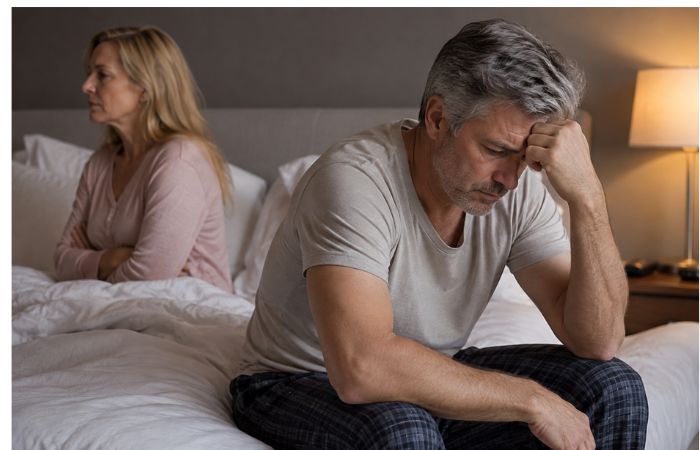
I believe the best way to talk to your partner about erectile dysfunction is to be honest before shame and anxiety start making decisions for you. If you are afraid of rejection, embarrassment, or disappointing the person you love, I understand why you may want to stay silent.
However, silence can create more confusion, distance, and pressure than the problem itself.
Your partner may assume you are no longer attracted to them, while you may begin to believe that you are failing.
I want you to know that erectile dysfunction is a health concern, not a personal defect.
In This Article
- I explain why I believe talking about ED is better than allowing both partners to guess what is happening.
- I describe the emotional effects of ED, including shame, anxiety, frustration, and fear of rejection.
- I show you how I would recognize and interrupt the performance-anxiety cycle.
- I share the words I would use to begin an honest conversation.
- I explain how I would reduce pressure during intimacy.
- I discuss lifestyle factors, medical evaluation, counseling, and sex therapy.
- I include research and clinical guidance about the emotional and physical sides of ED.
- I answer common questions about erectile dysfunction, anxiety, relationships, and treatment.
Why Talking About ED Matters
What happens when I stay silent?
When I avoid talking about ED, I may temporarily avoid embarrassment. However, I may also create confusion, emotional distance, and more anxiety.
My partner may wonder:
- “Is my partner still attracted to me?”
- “Did I do something wrong?”
- “Why are they avoiding intimacy?”
- “Is our relationship in trouble?”
At the same time, I may think:
- “What if it happens again?”
- “What if my partner judges me?”
- “Am I disappointing them?”
- “Will they tell someone else?”
- “Is something seriously wrong with me?”
These thoughts can create a cycle of fear and avoidance. I think an honest conversation is usually healthier than allowing both partners to guess what the other person is feeling.
How ED Can Affect Emotions
What might I feel?
Erectile dysfunction can affect much more than sexual performance. It can affect my confidence, mood, relationship, and willingness to be emotionally vulnerable.
- Shame:
I may feel embarrassed or uncomfortable talking about what is happening. - Frustration:
I may feel angry because my body is not responding the way I expect. - Sadness:
I may grieve the loss of confidence or the ease I once felt during intimacy. - Anger:
I may feel upset with myself, my body, or the situation. - Low self-esteem:
I may begin to judge my value or masculinity based on sexual performance. - Fear of rejection:
I may worry that my partner will lose interest or look elsewhere. - Fear of sexual failure:
I may expect intimacy to go badly before it even begins. - Anxiety before intimacy:
I may feel nervous, tense, or distracted before sexual activity. - A desire to avoid sex:
I may avoid intimacy because I am afraid of repeating the experience. - Worry about losing my partner:
I may fear that ED will permanently damage the relationship.
How might my partner feel?
My partner can also experience difficult emotions, even when ED is not caused by a lack of attraction.
- Rejected:
My partner may wrongly believe that I no longer desire them. - Unattractive:
My partner may take my erection difficulty personally. - Confused:
My partner may not know what is happening or how to help. - Lonely:
My partner may feel emotionally or physically disconnected. - Worried:
My partner may fear that ED signals a serious health or relationship problem. - Unsure how to offer support:
My partner may want to help but may be afraid of saying the wrong thing.
I believe both people can feel hurt without either person being to blame. That is why I would make space for both partners to talk about their emotions.
The Performance-Anxiety Cycle
How does ED anxiety develop?
One difficult sexual experience can create a powerful fear of repetition. I may start thinking about the next experience before intimacy even begins.
The cycle may look like this:
- I have difficulty getting or keeping an erection:
I notice that my body is not responding as I expected. - I feel embarrassed or worried:
I become concerned about disappointing my partner. - I expect the same problem next time:
I begin predicting failure before intimacy starts. - I monitor my body:
I focus on whether my erection is firm enough instead of focusing on pleasure. - I lose connection:
I stop paying attention to touch, affection, and my partner. - My anxiety increases:
I become tense and distracted. - The erection becomes more difficult:
The fear appears to confirm itself.
Cleveland Clinic describes sexual performance anxiety as fear, worry, or embarrassment that can affect sexual interest, pleasure, and performance.
I think the most important lesson is that anxiety can become part of the problem, even when ED originally began for another reason.
How I Would Start the Conversation
When would I talk?
I would not begin the conversation immediately after a difficult sexual experience. Both people may feel exposed, embarrassed, or defensive at that moment.
I would choose:
- A calm, private setting:
I would choose a place where we can speak without interruptions. - A time outside the bedroom:
I would avoid making the discussion feel like part of a sexual test. - A moment when neither person is rushing:
I would allow enough time to listen and respond carefully. - A time when we can listen without interruption:
I would avoid starting the conversation during an argument. - A setting where my partner feels emotionally safe:
I would make it clear that I want understanding rather than blame.
I would avoid starting the discussion by asking, “Why did that happen?” immediately after sex.
That question may sound simple, but it can feel like criticism when someone is already embarrassed.
What would I say?
I would begin with reassurance:
“I want to talk about something personal because I care about us. I have noticed that intimacy has sometimes felt stressful, and I do not want either of us to feel alone with it.”
Then I might say:
“This is not about blaming you or blaming myself. I want us to understand it together.”
This approach helps me communicate that I want connection, not criticism.
Why I Use “I” Statements
“I” statements allow me to explain my feelings without making my partner feel attacked. They also make the conversation more specific and less defensive.
What I might say
- “I have been feeling anxious before intimacy.”
I am describing my emotional experience instead of blaming my partner. - “I worry that you may think I am not attracted to you.”
I am sharing my fear openly. - “I feel embarrassed, but I want to be honest.”
I am showing vulnerability without treating ED as a personal failure. - “I would like us to take some pressure off.”
I am suggesting a practical way to reduce anxiety. - “I want to know how this has felt for you.”
I am making room for my partner’s emotions. - “I would like us to look for solutions together.”
I am presenting the issue as something we can address as a team.
What I would avoid saying
- “You never understand me.”
This can make my partner defend themselves instead of listening. - “You are making this worse.”
This may increase blame and emotional tension. - “Why can’t you just relax?”
This can make anxiety feel like a personal choice. - “You must not want me anymore.”
This may force my partner to defend their attraction instead of discussing ED. - “This is all your fault.”
Blame rarely creates the emotional safety needed for an honest conversation.
I think the difference is simple: one approach opens a conversation, while the other creates defensiveness.
How I Would Explain ED to My Partner
Erectile dysfunction means repeated difficulty getting or keeping an erection firm enough for sexual activity. One difficult experience does not automatically mean that I have ED.
ED can involve several physical, emotional, lifestyle, and relationship factors.
- Stress:
Ongoing mental or emotional pressure that can make arousal and erections more difficult. - Anxiety:
Persistent worry or fear that may create performance pressure during intimacy. - Depression:
A low mood that can reduce sexual desire, energy, and interest in intimacy. - Poor sleep:
Insufficient or disrupted sleep that may affect energy, mood, hormones, and sexual function. - Alcohol:
Excessive alcohol use that can interfere with the nervous system and reduce erection quality. - Smoking:
Tobacco use that can damage blood vessels and reduce blood flow to the penis. - Medication:
Certain prescription or over-the-counter medicines that may contribute to ED as a side effect. - Diabetes:
A condition that can damage the blood vessels and nerves involved in erections. - High blood pressure:
Elevated blood pressure that may affect blood-vessel health and penile blood flow. - Cardiovascular problems:
Heart or circulation conditions that can reduce the blood flow needed for an erection. - Hormonal changes:
Changes in testosterone or other hormones that may affect desire and erectile function. - Relationship tension:
Ongoing conflict, emotional distance, or unresolved problems that may increase sexual pressure. - Nerve or blood-flow problems:
Health conditions that interfere with the signals or circulation required for an erection.
The National Institute of Diabetes and Digestive and Kidney Diseases explains that ED may be connected to medicines, mental-health concerns, lifestyle behaviors, and other health conditions.
NIDDK also explains that treatment may include lifestyle changes, counseling, and medical therapies, depending on the cause.
What ED does not automatically mean
- I am no longer attracted to my partner:
ED can happen even when desire and emotional connection are still present. - My partner is unattractive:
Erectile difficulty is not a reliable measure of a partner’s appearance or desirability. - I am less masculine:
A health concern does not determine my identity or personal worth. - The relationship is failing:
Many couples remain close while addressing ED together. - I will never have satisfying sex again:
Treatment and changes in intimacy may improve connection and sexual satisfaction. - The problem is entirely psychological:
ED can involve physical causes, emotional causes, or a combination of both.
How I Would Reduce Pressure During Intimacy
Does intimacy have to end in penetration?
No. I think couples often need to change the goal instead of abandoning intimacy.
For a while, I might agree with my partner that intimacy does not have to end in penetration or orgasm. This can reduce the feeling that an erection must appear and remain for the experience to matter.
I would focus on:
- Kissing:
Affectionate kissing can help me stay connected without creating a performance requirement. - Touch:
Touch allows both partners to focus on physical connection rather than erection quality. - Massage:
Massage can create relaxation and closeness without requiring a sexual outcome. - Oral sex:
Oral sex may offer pleasure without making penetration the only goal. - Mutual stimulation:
Both partners can explore what feels good without treating erection as a requirement. - Cuddling:
Cuddling can maintain affection and emotional safety. - Sensual conversation:
Talking about desire and pleasure can reduce silence and misunderstanding. - Shared pleasure without a fixed outcome:
Removing the expected result can reduce performance anxiety.
I do not see this as giving up. I see it as creating a safer way to rebuild confidence and closeness.
What would I do if I lost my erection?
I would try not to panic or apologize repeatedly.
I might say:
“Let’s slow down. I still want to be close to you.”
Then I could continue another form of intimacy, take a break, or stop for the evening. This helps me remember that a change in arousal does not have to end the emotional connection.
How I Would Manage Anxiety Before Intimacy
What would I do before sex?
I would talk with my partner before intimacy begins. I might say:
“There is no pressure tonight. We can enjoy each other, and we can stop whenever we want.”
I would also try to:
- Sleep well:
Better rest may help me feel more energetic and less emotionally reactive. - Avoid heavy alcohol use:
Alcohol may reduce anxiety temporarily but can interfere with erection quality. - Choose a time when I am not exhausted:
Fatigue can make it harder to focus on pleasure and connection. - Reduce distractions:
A calmer environment may help me stay present. - Take slow breaths:
Controlled breathing may help me reduce physical tension. - Avoid repeatedly checking my erection:
Constant monitoring can increase performance pressure. - Focus on physical sensations:
I would pay attention to touch, warmth, breathing, and closeness. - Remind myself that intimacy is not a test:
I do not have to prove my worth through sexual performance.
A breathing technique I would use
I would inhale slowly for four seconds and exhale for six seconds. I would repeat this for one or two minutes while relaxing my shoulders, jaw, and stomach.
If an anxious thought appeared, I would say:
“I am having the thought that I will disappoint my partner.”
I would notice the thought without treating it as a fact. Then I would return my attention to touch, breathing, and connection.
What Current Research Tells Me
Cognitive behavior sex therapy
A pilot study by Bilal and Abbasi examined cognitive behavior sex therapy in young men with non-organic ED.
The researchers reported improvements in erectile functioning and anxiety, although the study was small and cannot prove that the method works for everyone.
I take the practical lesson seriously: when anxiety contributes to ED, addressing thoughts, fear, and sexual pressure may help.
Recent expert recommendations
A 2025 expert panel review recommended a holistic approach to ED that considers medical, psychological, and relationship factors.
The review discussed psychosexual counseling and couples therapy as possible parts of care.
A 2025 review in Sexual Medicine Reviews also emphasized shared decision-making and attention to the partner’s experience.
I would not assume that emotional support must replace medical treatment. In many cases, I believe both may be useful.
When I Would Seek Professional Help
When should I get support?
I would consider professional help when ED or anxiety begins affecting my relationship, mood, sleep, confidence, or daily life.
- ED continues or becomes more frequent:
Repeated symptoms deserve medical attention instead of continued guessing. - Anxiety appears before nearly every intimate moment:
Frequent fear may signal a performance-anxiety cycle that needs support. - Sex and affection are being avoided:
Avoidance can increase emotional distance and loneliness. - Arguments about attraction are increasing:
Repeated conflict may make both ED and anxiety more difficult. - Shame affects sleep, work, or mood:
Emotional distress deserves attention just like physical symptoms. - Depression, panic, or trauma is present:
Mental-health support may be an important part of recovery. - My partner and I cannot discuss the issue calmly:
Couples counseling can provide structure and emotional safety. - I feel hopeless or emotionally isolated:
I would seek support rather than trying to carry the problem alone.
NIDDK notes that counseling may help when anxiety, stress, or other emotional concerns affect ED.
Who could help?
- Primary-care clinician:
I could start here for an overall health review, medication review, and basic evaluation. - Urologist:
A urologist can evaluate erection problems and discuss treatment options. - Licensed therapist:
A therapist can help with anxiety, depression, shame, and self-esteem. - Qualified sex therapist:
A sex therapist can help with performance anxiety, intimacy, and sexual communication. - Couples counselor:
A couples counselor can help both partners communicate without blame.
Cleveland Clinic explains that sex therapists can help individuals and couples address performance anxiety, intimacy concerns, and sexual communication.
I would still seek a medical evaluation because anxiety can contribute to ED, but physical causes may also be present.
Medical Signs I Would Not Ignore
I would seek medical advice if ED is persistent or occurs with any of the following concerns:
- Pain during sex or erections:
Pain may indicate a condition that needs medical evaluation. - A new bend or change in penile shape:
A sudden physical change should be discussed with a clinician. - Urinary problems:
Changes in urination may point to another health concern. - Changes in ejaculation:
New ejaculation changes may require an evaluation. - A sudden reduction in sexual desire:
A sudden change may be related to mood, hormones, medication, or another condition. - Diabetes symptoms:
Diabetes can affect blood vessels and nerves involved in erections. - High blood pressure:
High blood pressure can affect blood-vessel health and sexual function. - A new medication:
Some medicines may contribute to ED as a side effect. - An injury or surgery:
Nerve or blood-flow changes after injury or surgery may affect erections.
I would also avoid unregulated ED supplements purchased online. Some products may contain hidden ingredients or interact with prescription medication.
I think a professional evaluation is safer than guessing.
Questions and Answers About ED Anxiety
Can anxiety cause erectile dysfunction?
Yes. Anxiety can contribute to ED or make an existing physical problem worse.
Worry increases mental pressure and may prevent a person from focusing on arousal and pleasure.
I would not assume anxiety is the only cause, though. Persistent ED deserves a medical evaluation.
How do I tell my partner that ED is not about attraction?
I would use clear, direct language:
“I want you to know that this is not a measure of how attracted I am to you. I am dealing with anxiety and a physical problem, but my feelings for you have not disappeared.”
I would repeat this reassurance through both words and affection.
What should I say after losing my erection?
I might say:
“I am still attracted to you. I think I am feeling pressure right now, so I would like to slow down.”
This explains what is happening without turning the moment into a crisis.
Should we stop having sex completely?
I would not necessarily stop all intimacy. Instead, I would remove the expectation that every intimate experience must involve penetration.
Touch, kissing, massage, oral sex, and other mutually desired activities can help preserve closeness while reducing performance pressure.
Can my partner’s reaction make anxiety worse?
Yes. Criticism, jokes, repeated questions, or visible disappointment may increase pressure.
At the same time, I believe my partner’s feelings also deserve attention. Both people can communicate honestly without blaming each other.
Is ED always a sign of a serious health problem?
No. Stress, tiredness, alcohol, medications, sleep problems, and anxiety can contribute.
However, ED may also be associated with cardiovascular, hormonal, nerve, or metabolic conditions. That is why I would not ignore repeated symptoms.
Should I use ED medication?
Only after discussing it with a qualified healthcare professional. Medication may be appropriate for some people, but it can be unsafe with certain heart medicines and health conditions.
I would never assume that an online supplement is safe because it is labeled “natural.”
Can therapy help if ED has a physical cause?
Yes. Therapy may not remove the physical cause, but it can help reduce shame, anxiety, avoidance, and relationship tension.
Cleveland Clinic notes that counseling focused on sexual health may help with guilt or anxiety contributing to ED, even when a physical cause is present.
Can a relationship remain strong despite ED?
Yes. I believe couples can remain emotionally and sexually connected by communicating honestly, reducing performance pressure, exploring different forms of intimacy, and seeking appropriate support.
ED may change how a couple approaches sex, but it does not determine the strength of the relationship.
Final Thoughts
I want you to remember that erectile dysfunction can affect confidence and emotional closeness, but it does not define your worth.
I would focus on three steps:
- Replace secrecy with honest communication:
I would talk before shame and anxiety create more distance. - Replace performance pressure with shared pleasure:
I would remember that intimacy is larger than penetration. - Replace self-blame with medical and emotional support:
I would seek qualified help instead of trying to solve everything alone.
You do not need to solve everything in one conversation. You only need to begin with honesty.
I would start with this:
“I feel embarrassed and anxious, but I do not want us to face this separately.”
That sentence may not solve ED immediately. It can, however, create the understanding and emotional safety needed to move forward together.
Medical Disclaimer
This article is for general educational purposes and does not replace medical advice, diagnosis, or treatment.
If erectile dysfunction is persistent, painful, worsening, or causing significant emotional distress, I recommend speaking with a qualified healthcare professional.
Sources:
https://health.clevelandclinic.org/sexual-performance-anxiety
https://www.niddk.nih.gov/health-information/urologic-diseases/erectile-dysfunction/definition-facts
https://pmc.ncbi.nlm.nih.gov/articles/PMC12703098/
https://academic.oup.com/smr/article/13/4/513/8221489
https://my.clevelandclinic.org/health/articles/24524-sex-therapist

Richard Amaro, is a renowned writer, sex therapist, and coach, with years of experience helping individuals and couples enhance their relationships and intimacy. Read more about me…