What Are The Best Supplements That Improve Circulation for Men?
The best circulation supplements for men’s sexual performance are the ones that target nitric oxide through more than one pathway at once, since that molecule is directly responsible for relaxing blood vessels and increasing blood flow during arousal.
I want to walk you through exactly which ingredients the research actually supports, and why combining certain ones works better than relying on just one.
In This Article You Will Find
- Why nitric oxide sits at the center of circulation and sexual performance
- The two separate pathways your body uses to produce nitric oxide
- Which specific ingredients have real research behind them
- Why combining ingredients from both pathways works better than one alone
- What to realistically expect, and when to talk to a doctor
Why Circulation Is the Real Foundation of Sexual Performance
An erection depends entirely on blood vessels relaxing and widening enough to let more blood flow in than flows out.
Nitric oxide is the molecule that triggers that exact response.
As men age, blood vessels naturally become less elastic, and nitric oxide production tends to decline.
Reduced physical activity, weight gain, and chronic stress all make this worse over time.
This is exactly why circulation supplements built around nitric oxide have become such a focus of recent research.
The Two Pathways Your Body Uses to Make Nitric Oxide
Here’s something I think most articles gloss over, and it actually matters a lot.
Your body produces nitric oxide through two separate, independent pathways.
The first is the L-arginine to nitric oxide pathway, where an enzyme in the blood vessel lining converts the amino acid L-arginine directly into nitric oxide.
The second is the nitrate to nitric oxide pathway, where dietary nitrates, found in foods like beetroot, get converted into nitric oxide through a completely different chemical route.
Supplements that target both pathways at once tend to work better than ones that only address a single route, since one pathway can partially compensate if the other is underperforming.
L-Arginine: The Direct Nitric Oxide Building Block
L-arginine is absorbed quickly and is particularly useful for short-term blood flow support, which is why it’s common in pre-workout and circulation formulas.
Its effect doesn’t last as long in the bloodstream compared to other options, largely due to how quickly the body metabolizes it.
L-Citrulline: The More Efficient Pathway
L-citrulline is an amino acid the kidneys convert into L-arginine, which is then used to produce nitric oxide.
Research shows oral citrulline increases plasma arginine levels more effectively than taking arginine directly, since citrulline bypasses first-pass liver metabolism.
A 2019 meta-analysis in the European Journal of Nutrition found significant reductions in both systolic and diastolic blood pressure from L-citrulline supplementation at doses of 3 to 6 grams daily.
Because of this superior bioavailability, L-citrulline tends to produce more sustained nitric oxide production throughout the day compared to L-arginine alone.
Beetroot Extract: The Second Pathway
Beetroot is naturally rich in dietary nitrates, which the body converts into nitric oxide through the completely separate nitrate-nitrite-NO pathway.
Clinical research shows beetroot supplementation improves endurance, lowers blood pressure, and enhances oxygen delivery to muscles.
Most clinical effects are seen at 300 to 500 milligrams of dietary nitrate, roughly equivalent to 500 milliliters of beetroot juice or a standardized supplement dose.
Why Combining All Three Is the Strongest Approach
This is the part I think matters most.
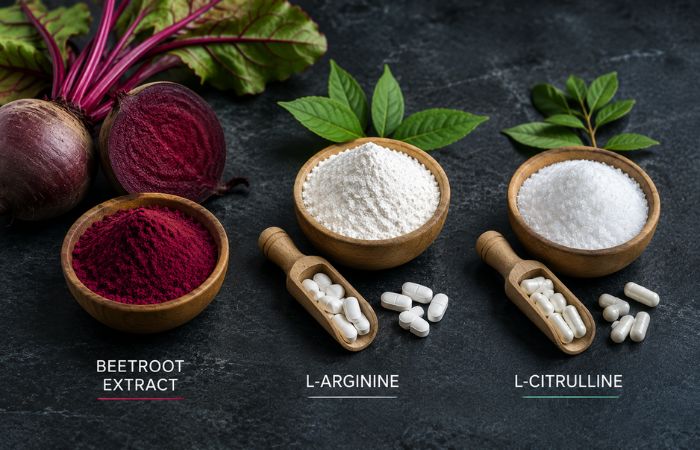
Using L-arginine and L-citrulline together supports the eNOS pathway, while beetroot extract supports the completely separate nitrate pathway at the same time.
This dual pathway approach means that even if one system underperforms, due to aging, endothelial dysfunction, or other factors, the other pathway can partially compensate.
Nitric Boost Ultra is one formula built around exactly this combination, including L-Arginine, L-Citrulline, and Beet Root Powder together to target nitric oxide production from both pathways at once.
I think this layered approach reflects where the actual research points, rather than betting everything on a single ingredient.
A Few Important Safety Notes
Circulation supplements are generally well tolerated, but a few things are worth knowing.
Several ingredients in this category, including garlic and ginkgo biloba, can affect blood clotting and carry real interaction risks with blood thinning medications like warfarin.
Nitric oxide supplements in general can lower blood pressure, which matters if you already take blood pressure medication or nitrate based drugs.
Always talk to a doctor before starting any circulation supplement, especially if you have an upcoming surgery, take blood thinners, or manage an existing cardiovascular condition.
What to Realistically Expect
Timelines vary depending on what you’re targeting.
Beetroot juice can produce measurable blood pressure changes within two to three hours of a single dose.
L-arginine and L-citrulline typically show effects within days to a few weeks of consistent use.
Supplements work best when combined with exercise, a nitric oxide supportive diet, and other lifestyle changes, not as a standalone fix.
Frequently Asked Questions About Circulation Supplements for Men
What is the best supplement for improving circulation and sexual performance?
Ingredients that support nitric oxide through more than one pathway, specifically L-arginine, L-citrulline, and beetroot extract together, have the strongest combined evidence for circulation and sexual performance.
Is L-citrulline better than L-arginine for blood flow?
Generally, yes, for sustained effects. L-citrulline has higher bioavailability and produces more consistent nitric oxide production throughout the day, though L-arginine still offers useful short-term support.
How does beetroot improve circulation?
Beetroot is rich in dietary nitrates, which the body converts into nitric oxide through a separate pathway than amino acids like L-arginine, directly supporting vasodilation and blood flow.
How long does it take circulation supplements to work?
Beetroot can show measurable effects within hours of a single dose, while L-arginine and L-citrulline typically take days to a few weeks of consistent use to show meaningful results.
Are circulation supplements safe to combine with other medications?
Not always without guidance. Ingredients like garlic and ginkgo can interact with blood thinners, and nitric oxide supplements can lower blood pressure, so a doctor should review your specific medications first.
Final Thoughts
The strongest circulation supplements for men’s sexual performance are the ones that hit nitric oxide from more than one angle, L-arginine and L-citrulline through one pathway, beetroot through another.
This dual pathway approach has the strongest theoretical and clinical foundation of any strategy currently used in this category.
Nitric Boost Ultra combines exactly these three ingredients in one formula, built around this same layered approach.
If you want to see the full ingredient breakdown and how it’s formulated, you can visit the Official Website directly, or read our complete Nitric Boost Ultra review for a deeper look at how the formula works.
Sources:
https://alimentacion.conahcyt.mx/produccionsinglifosato/wp-content/uploads/Residuos/316133ARTICULO.pdf
https://pubmed.ncbi.nlm.nih.gov/8273987
https://www.europeanurology.com/article/S0302-2838(03)00575-X/fulltext
https://journals.physiology.org/doi/full/10.1152/japplphysiol.00372.2013?utm_source
https://www.health.harvard.edu/diseases-and-conditions/decoding-poor-circulation

Richard Amaro, is a renowned writer, sex therapist, and coach, with years of experience helping individuals and couples enhance their relationships and intimacy. Read more about me…