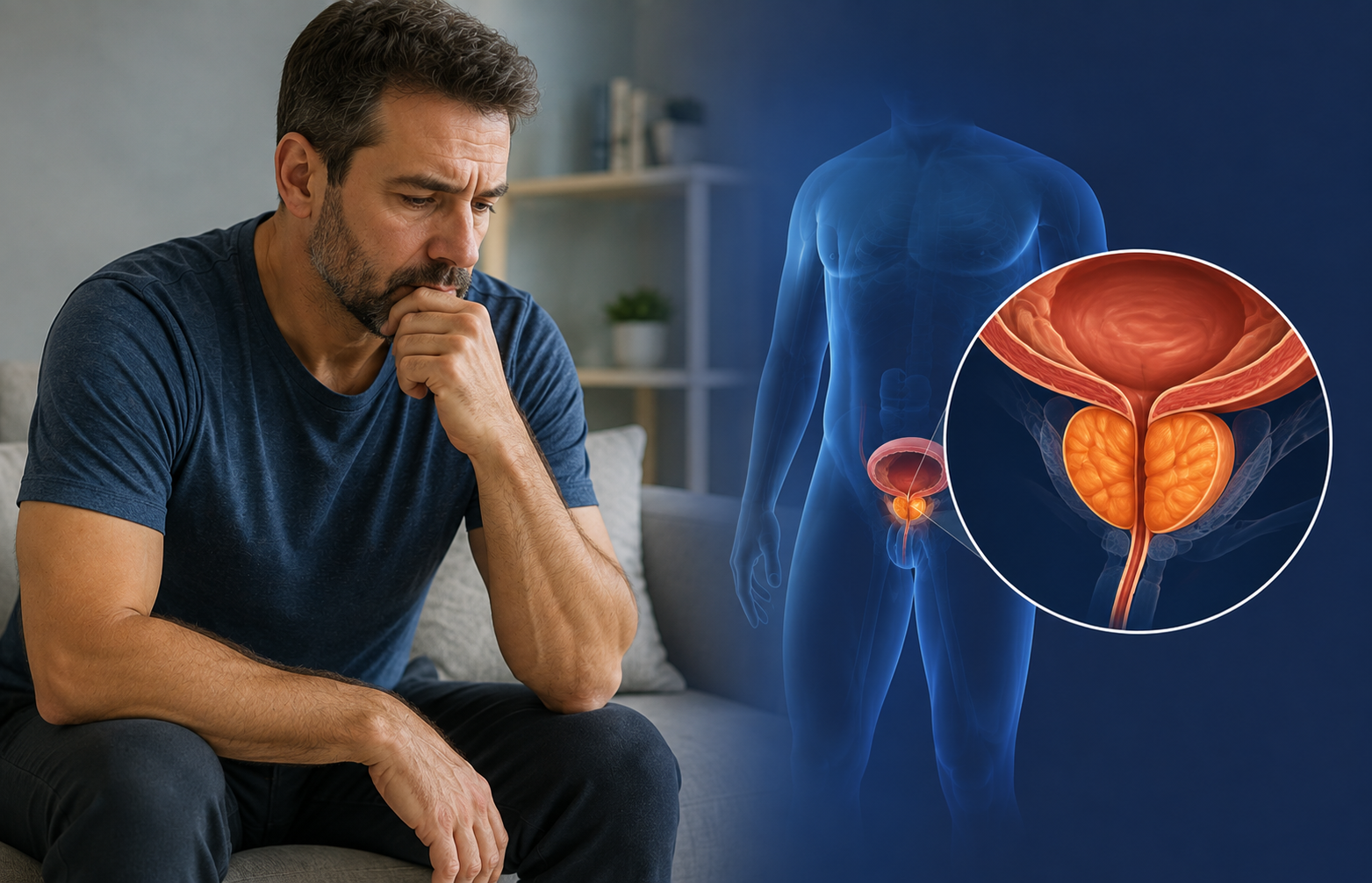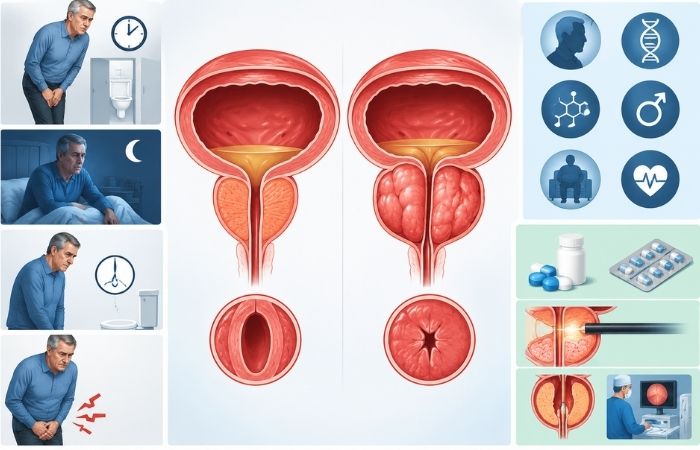
Benign prostatic hyperplasia (BPH), or enlarged prostate, is a common condition where the prostate gland grows larger with age. This growth is not cancer and does not cause cancer, but it can press on the urethra and create urinary symptoms like frequency, urgency, and weak flow.
An enlarged prostate affects roughly half of men in their 60s and up to 90 percent of men in their 80s.
If you are a man over 50, understanding this condition helps you recognize symptoms early.
The good news is that BPH is not life-threatening and not cancer.
Even better, numerous effective treatments exist ranging from watchful waiting to medications to minimally invasive procedures.
Understanding BPH transforms it from a mysterious problem into a manageable condition.
You move from confusion and worry to clarity and options.
In This Article We Cover
- What the prostate is and why it matters
- How enlarged prostate differs from cancer
- Why the prostate grows larger as men age
- The exact symptoms men with BPH experience
- How prostate enlargement affects urinary function
- Causes and risk factors for developing BPH
- The biological process behind prostate growth
- Myths that create unnecessary fear
- What most men do when symptoms appear
- Medical treatments that reduce symptoms
- Lifestyle changes that help manage BPH
- Questions to ask your doctor
What Is the Prostate and Why Does It Matter?
Understanding the Prostate Gland
Your prostate is a walnut-sized gland that sits just below your bladder and surrounds the urethra, the tube that carries urine from your bladder.
The prostate produces fluid that nourishes and protects sperm.
This gland is crucial to sexual and reproductive function. It contracts during ejaculation to propel semen forward.
Understanding its location helps explain why an enlarged prostate affects urination.
The Location Problem
Because the urethra passes through the center of the prostate, any growth of the gland squeezes this tube.
Imagine a hose running through a balloon. When the balloon inflates, it compresses the hose.
This compression is the root of urinary symptoms in BPH.
The prostate grows, the urethra narrows, and urinary flow weakens.
What Is Benign Prostatic Hyperplasia (BPH)?
The Medical Definition
Benign prostatic hyperplasia means the prostate has enlarged but remains non-cancerous.
Benign means not cancer. Hyperplasia means the tissue has grown.
This distinction matters enormously. Many men fear prostate enlargement means cancer.
It does not. BPH and prostate cancer are separate conditions with different causes, different treatments, and different outcomes.
BPH Is Not Cancer
An enlarged prostate will not turn into cancer. You cannot catch cancer from BPH.
Men with BPH have the same risk of developing prostate cancer as men without BPH.
This separation is crucial to understand.
Having BPH does not increase your cancer risk and does not mean cancer is developing.
How Common BPH Is
BPH affects the vast majority of older men. By age 60, roughly 50 percent have some prostate enlargement.
By age 70, this rises to 60 percent. By age 80 and beyond, up to 90 percent have some degree of enlargement.
BPH is so common that it is considered a normal part of male aging, not a disease or failure of the body.
Why the Prostate Enlarges: Causes and Risk Factors
Age as the Primary Factor
The single strongest predictor of BPH is age. The longer you live, the more likely your prostate will enlarge.
No man is immune to this change as he ages.
This is not something you cause or something you failed to prevent.
Prostate enlargement happens to virtually all men given enough time.
Hormonal Changes
A hormone called dihydrotestosterone (DHT) drives prostate growth.
As men age, testosterone converts to DHT at higher rates, and prostate cells become more sensitive to DHT.
The prostate needs some testosterone to function normally. But excess DHT stimulates excessive growth.
This hormonal shift is the biological mechanism behind BPH.
Genetic Predisposition
Family history influences BPH development. If your father or other close male relatives had enlarged prostate, your risk is higher.
Genetics accounts for roughly 50 percent of BPH variation.
Having a family history does not guarantee you will develop BPH, but it does increase likelihood.
Race and Ethnicity
African American men tend to develop BPH earlier and more severely than men of other racial backgrounds.
Caucasian men typically develop it at moderate rates. Asian men show lower average rates.
These differences likely reflect both genetic and lifestyle factors working together.
Lifestyle Factors
Obesity increases BPH risk. Men who are overweight show higher rates of enlargement and more severe symptoms.
Weight loss often improves symptoms.
Sedentary lifestyle contributes to BPH development. Regular physical activity reduces risk.
Metabolic conditions like diabetes and high blood pressure increase BPH risk.
Dietary Influences
High fat intake, particularly red meat consumption, correlates with increased BPH risk.
Diets rich in vegetables and plant-based foods show protective effects.
Adequate vitamin D appears protective. Men with low vitamin D levels show higher BPH rates.
Recognizing BPH: Symptoms and Signs
Lower Urinary Tract Symptoms
BPH creates what doctors call lower urinary tract symptoms.
These symptoms result from the enlarged prostate squeezing the urethra and irritating the bladder.
Symptoms range from mild to severe. Some men have minimal bother. Others find symptoms significantly interfere with daily life.
Urinary Frequency
Needing to urinate more often, both day and night, is a hallmark of BPH.
Some men urinate eight to ten times daily or wake multiple times nightly to urinate.
Nocturia, or nighttime urination, particularly affects sleep quality. Frequent waking disrupts restful sleep.
Urinary Urgency
A persistent urge to urinate even when bladder contains little urine creates constant restlessness.
This urgency can occur suddenly and feel intense.
The combination of frequency and urgency means constantly thinking about where bathrooms are located.
Weak Urinary Stream
The stream of urine becomes noticeably weaker. Urination takes longer. You may notice the stream stops and starts rather than flowing smoothly.
A slow, weak stream results directly from the enlarged prostate narrowing the urethra.
Difficulty Emptying the Bladder
Some men feel the bladder is not completely empty after urination. This sensation of residual urine is common with BPH. The enlarged prostate prevents complete emptying.
Post-void dribbling, where urine dribbles out after you think you have finished, also occurs.
Other Symptoms
Hesitancy or difficulty starting urination happens in many men with BPH.
Straining to urinate is common.
Some men experience pain or discomfort during or after urination, though this is less common with BPH alone.
Symptom Severity Varies Widely
Some men have significant prostate enlargement on imaging but minimal symptoms. Others have moderate enlargement but severe symptoms.
The relationship between prostate size and symptom severity is not perfectly predictable.
Two men with similar sized prostates may have very different symptom experiences.
How Prostate Enlargement Affects Urinary Function
The Mechanical Compression
As the prostate grows, it gradually compresses the urethra, narrowing the passage through which urine flows.
Imagine a tube running through an expanding balloon. The tube gradually gets squeezed.
This physical compression is the primary mechanism creating symptoms. A smaller passageway means weaker flow and difficulty emptying.
Bladder Response to Obstruction
When urine flow is obstructed, the bladder must work harder to push urine through.
The bladder muscle thickens and becomes hyperactive to compensate.
This overactive bladder triggers frequent urges to urinate even when the bladder contains relatively small amounts of urine.
The sensitized bladder sends constant signals to urinate.
Incomplete Emptying
Because the enlarged prostate obstructs flow, urine cannot be expelled completely. Residual urine remains in the bladder after urination.
This retained urine increases urinary tract infection risk and can damage the bladder over time with prolonged obstruction.
The Progressive Nature
BPH tends to progress slowly. The prostate continues growing, the obstruction worsens, and symptoms gradually increase.
This is not usually rapid but rather a gradual process over years.
Some men experience stable symptoms for years. Others see gradual worsening. A small percentage experience sudden worsening.
Common Misconceptions About Enlarged Prostate
Myth: Enlarged Prostate Causes Cancer
This is false. An enlarged prostate will not cause prostate cancer. The two conditions are completely separate. Having BPH does not increase cancer risk.
Myth: BPH Results from Sexual Activity or Masturbation
False. Sexual frequency has no connection to prostate enlargement. This is purely an age-related hormonal condition, not caused by sexual behavior.
Myth: All Enlarged Prostates Need Treatment
False. Many men with significant prostate enlargement have minimal or no symptoms. If symptoms are not bothersome, treatment is not necessary. Watchful waiting is appropriate for many men.
Myth: Enlarged Prostate Means You Are Less Masculine
False. Prostate enlargement happens to virtually all men with sufficient age. It is a normal biological change with no connection to masculinity or virility.
Myth: Only Older Men Develop BPH
While BPH primarily affects older men, it occasionally occurs in younger men. Most men over 50 have some degree of enlargement even if asymptomatic.
Myth: Once You Have Symptoms, They Only Get Worse
While BPH often progresses, symptoms sometimes stabilize or even improve. Some men experience minimal symptom change for years. Treatment or lifestyle changes may improve symptoms.
What Men Typically Do When BPH Symptoms Appear
The Denial Response
Many men initially deny or minimize symptoms. They accept frequent urination as normal aging without investigating. This denial means missing opportunities for early symptom management.
The Self-Care Approach
Some men try lifestyle modifications alone. Reducing fluid intake, limiting evening drinking, or planning bathroom breaks help some men manage symptoms without medication.
This approach works for mild symptoms. More moderate or severe symptoms usually require additional intervention.
The Supplement Path
Many men turn to over-the-counter supplements, particularly saw palmetto. While some men report symptom improvement, research shows mixed results. Supplements work for some men but not others.
Supplements are generally safe but should complement rather than replace medical evaluation.
The Doctor Consultation
Men with bothersome symptoms eventually visit their doctor for evaluation. Doctors assess symptom severity, perform physical examination, and sometimes order testing.
This step transforms BPH from a mystery into a manageable condition.
Treatment Options for Enlarged Prostate
Watchful Waiting: The Initial Approach
For men with mild symptoms that do not significantly impact quality of life, watchful waiting is often recommended. You do not take medications or pursue treatment, but you monitor symptoms closely.
Annual or semi-annual visits track whether symptoms are stable, improving, or worsening. This approach is safe for most men and avoids unnecessary treatment.
Watchful waiting can continue indefinitely if symptoms remain stable and acceptable. Many men never need additional treatment.
Lifestyle Modifications
Reducing evening and nighttime fluid intake decreases urinary frequency and nocturia. Limiting caffeine and alcohol, which irritate the bladder, often helps.
Scheduled urination, where you void on a regular schedule rather than waiting for urgency, improves some symptoms.
Double voiding, where you urinate, relax, and urinate again, helps ensure complete emptying.
Regular physical activity improves BPH symptoms in many men. Weight loss also improves symptoms in overweight men.
Medication: Alpha-Blockers
Alpha-blockers relax smooth muscle in the prostate and bladder neck, improving urine flow. These medications work quickly, often showing benefits within days to weeks.
Common alpha-blockers include tamsulosin and doxazosin. Side effects are generally mild and may include dizziness or reduced sexual function in some men.
Alpha-blockers reduce symptoms but do not shrink the prostate. Symptoms may return if you stop the medication.
Medication: 5-Alpha Reductase Inhibitors
These medications, including finasteride and dutasteride, reduce DHT production and actually shrink the prostate over time. They work more slowly than alpha-blockers, requiring four to six months to see full benefit.
These medications are most effective for men with larger prostates. Benefits continue as long as you take the medication.
Side effects may include reduced sexual function and ejaculation changes in some men. Breast tenderness occasionally occurs.
Combination Therapy
For men with moderate to severe symptoms, combining an alpha-blocker with a 5-alpha reductase inhibitor often produces better results than either alone. The alpha-blocker provides quick relief while the inhibitor gradually shrinks the prostate.
Minimally Invasive Procedures
Transurethral microwave thermotherapy (TUMT) uses microwave heat to destroy prostate tissue.
The procedure takes one to two hours and can be done as outpatient surgery with local anesthesia.
Transurethral needle ablation (TUNA) uses radiofrequency energy to destroy prostate tissue. Recovery is faster than traditional surgery.
These procedures carry less risk than traditional surgery but may produce less dramatic symptom improvement.
They suit men seeking alternatives to medication or traditional surgery.
Surgical Treatment
Transurethral resection of the prostate (TURP) is the most common surgical approach.
Using a special instrument inserted through the urethra, the surgeon removes excess prostate tissue.
TURP provides excellent symptom relief but carries risks including infection, bleeding, and erectile dysfunction. Recovery takes several weeks.
Open prostatectomy is reserved for very large prostates and involves making an incision to remove excess tissue.
This approach provides excellent results but requires longer recovery.
Choosing the Right Treatment
The right treatment depends on prostate size, symptom severity, your preferences, and your overall health.
Some men prefer medication and accept ongoing treatment. Others prefer a single procedure.
Your doctor helps you weigh the options and choose the approach that best fits your situation and values.
Key Takeaways About Enlarged Prostate
Enlarged prostate is extremely common as men age and is not cancer. BPH affects most men eventually but does not require treatment unless symptoms bother you.
Symptoms result from the enlarged prostate squeezing the urethra. Urinary frequency, urgency, weak flow, and difficulty emptying are the most common complaints.
Age and hormonal changes are the primary drivers. Genetics, lifestyle factors, and health conditions also influence development and severity.
Numerous effective treatments exist. Watchful waiting, medications, lifestyle changes, minimally invasive procedures, and surgery all have roles depending on individual circumstances.
Many men successfully manage BPH for years without medications or procedures. Treatment is not one-size-fits-all. Your doctor helps determine what is appropriate for you.
Questions to Ask Your Doctor
Understanding Your Diagnosis
Ask how large your prostate is. Ask whether they are certain this is BPH and not another condition.
Ask whether your symptoms are typical for prostate size or whether other factors might be contributing.
About Testing
Ask what tests are being performed and why. Ask whether imaging like ultrasound is needed. Ask whether a urinalysis or post-void residual measurement is recommended.
Treatment Recommendations
Ask which treatment options are appropriate for your specific situation. Ask about expected benefits and timeline for improvement with each option. Ask about side effects and risks.
Lifestyle Factors
Ask which lifestyle modifications might help your symptoms. Ask about fluid intake recommendations. Ask whether exercise, weight loss, or dietary changes would benefit you.
Monitoring and Follow-Up
Ask how often you should have follow-up appointments. Ask what symptoms should prompt you to call before your next scheduled visit. Ask what changes would indicate need for treatment.
Sexual and Urinary Function
Ask about potential impacts of any proposed treatment on sexual function. Ask whether symptoms might improve with treatment. Ask about post-void residual monitoring.
Frequently Asked Questions
Is an enlarged prostate the same as prostate cancer?
No. BPH and prostate cancer are completely separate conditions. Having BPH does not cause cancer and does not increase cancer risk. They have different causes, symptoms, and treatments.
How common is BPH in older men?
Very common. Roughly 50 percent of men in their 60s have some prostate enlargement. This rises to 80 to 90 percent in men over 80. It is considered a normal part of male aging.
Can BPH symptoms go away on their own?
Symptoms may stabilize and sometimes improve without treatment. Some men experience minimal symptom progression for years. Others see gradual worsening. Individual variation is significant.
Do I need treatment if I have no symptoms?
No. If your prostate is enlarged but you have no symptoms or only minimal bothersome symptoms, treatment is not recommended. Watchful waiting is appropriate.
How quickly do medications work for BPH?
Alpha-blockers work within days to weeks. 5-alpha reductase inhibitors require four to six months to produce full benefit. Combination therapy takes time for the inhibitor component to work.
What are the side effects of BPH medications?
Alpha-blockers may cause dizziness, fatigue, or reduced sexual function in some men. 5-alpha reductase inhibitors may reduce libido or cause ejaculation changes. Most men tolerate the medications well.
Is prostate surgery necessary for all enlarged prostates?
No. Surgery is reserved for men with moderate to severe symptoms that have not responded to medication or who prefer a surgical solution. Many men manage BPH successfully without surgery.
Can I prevent prostate enlargement?
You cannot prevent BPH entirely as it is linked to aging, but maintaining healthy weight, staying physically active, and eating a healthy diet may slow progression.
Will my symptoms get worse if I wait?
Symptoms may worsen, stabilize, or occasionally improve. While BPH tends to progress slowly, the rate of progression varies greatly between men. Regular monitoring helps track changes.
What is the best treatment for BPH?
The best treatment is the one that improves your symptoms to a degree you find acceptable while fitting your preferences and values. This differs from person to person. Your doctor helps you determine what works best for you.
Source:
https://www.pennmedicine.org/conditions/male-hypogonadism
https://www.bcm.edu/healthcare/specialties/urology/mens-health/testosterone-replacement-therapy
https://medschool.umich.edu/health-lab-podcast/new-research-gender-affirming-testosterone-and-fertility
https://urology.stanford.edu/patient_care/patient_care.html

Richard Amaro, is a renowned writer, sex therapist, and coach, with years of experience helping individuals and couples enhance their relationships and intimacy. Read more about me…