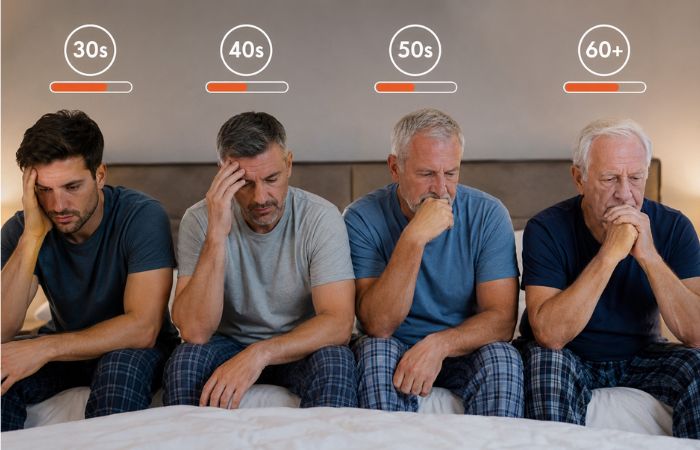
It usually starts quietly.
One night, things do not work the way they used to.
You assume it was stress, alcohol, or a bad week,and often, it is.
But then it happens again, and the question becomes harder to ignore:
Is this normal for my age, or is something else going on?
Erectile dysfunction becomes more common with age, but it is not an automatic part of getting older.
Occasional difficulty can happen at 30, 45, or 65.
Persistent ED, however, deserves attention because it can reflect stress, sleep problems, medication side effects, hormone changes, or issues with blood flow and metabolic health.
This guide breaks down what tends to change at 30, 40, 50, and 60+, what is usually temporary, and when it makes sense to speak with a doctor.
Quick Answer: ED by Age
| Age | What is more likely | When to pay attention |
|---|---|---|
| 30s | Stress, performance anxiety, poor sleep, alcohol, smoking, or medication effects | Difficulty persists for several weeks or happens without an obvious trigger |
| 40s | Lifestyle changes, early blood-pressure or metabolic issues, rising stress | ED becomes regular or appears alongside fatigue, weight gain, or other health changes |
| 50s | Cardiovascular risk, prediabetes or diabetes, sleep apnea, medications | ED is consistent, sudden, or affects your confidence and relationship |
| 60+ | Vascular changes, chronic conditions, multiple medications, prostate treatment | ED affects quality of life or begins after a new diagnosis, surgery, or medication |
Erectile dysfunction is common: estimates suggest that more than half of men between 40 and 70 experience some degree of ED, though severity and causes vary widely.
What You’ll Find in This Article
- How erectile dysfunction changes with age at 30, 40, 50, and 60+
- Why age affects erectile function and what else plays a role
- The difference between normal occasional issues and persistent problems
- Common causes specific to each age group
- Steps you can take at any age
What Counts as Erectile Dysfunction?
Erectile dysfunction means having ongoing difficulty getting or keeping an erection firm enough for sexual activity.
One difficult night does not mean you have ED.
- Stress
- Tiredness
- Alcohol
- Anxiety
Temporary health issue can all affect erections from time to time.
Doctors generally consider it ED when the problem is consistent and lasts for several weeks or months.
The Mayo Clinic describes a clinically significant pattern as a persistent inability to get or maintain an erection adequate for intercourse lasting more than three months.
ED is also not simply “low libido.” You may still want sex but have trouble with the physical response.
Or you may have occasional erections, including morning erections, but struggle during partnered sex because of anxiety, stress, or relationship tension.
Why Erections Depend on More Than Age
An erection is a blood-flow event.
When you become aroused, nerves signal blood vessels in the penis to relax.
Blood flows in, pressure builds, and the erection is maintained.
That process depends on healthy blood vessels, nerve function, hormone levels, and a nervous system that is not stuck in stress mode.
That is why ED is not just a “sex problem.” It can be influenced by:
- Sleep
- Mental health
- Cardiovascular health
- Diabetes
- Smoking
- Alcohol
- Medications
- And relationship stress
The encouraging part: many causes are treatable or manageable, especially when identified early.
ED at 30: Usually Stress, Sleep, or Anxiety-Not “Getting Old”
Erectile problems are less common in your 30s, but they are not rare.
Research estimates vary, but somewhere between 1% and 14% of men under 40 may experience ED, depending on how it is defined and measured.
At this age, the cause is often more psychological or lifestyle-related than age-related.
Common triggers in your 30s
- Work pressure, financial stress, or relationship conflict
- Performance anxiety after one difficult experience
- Poor sleep, burnout, or chronic fatigue
- Heavy alcohol use, smoking, vaping, or recreational drugs
- Depression, anxiety, or high everyday stress
- Certain antidepressants, blood-pressure medications, or other prescriptions
- Low physical activity, excess weight, or early metabolic issues
A useful way to think about ED in your 30s is this: if it happens mainly during stressful periods, after drinking, or when you feel pressured, the issue may be temporary.
If it happens consistently, even when you feel relaxed and rested, it is worth a medical conversation.
What to do first
Focus on recovery and confidence rather than panic.
Prioritize sleep, reduce alcohol, exercise regularly, and avoid treating every difficult experience as proof that something is permanently wrong.
If anxiety becomes the main driver, a doctor or sex therapist can help you break the cycle of worry and self-monitoring.
ED at 40: The Decade When Small Health Signals Matter
Your 40s are often when lifestyle and health patterns begin to show up more clearly.
Occasional difficulty becomes more common, but persistent ED is still not inevitable.
Around 40% of men at age 40 are estimated to experience some degree of ED, although that figure includes mild and occasional symptoms, not only severe ED.
This is also a decade when early signs of high blood pressure, high cholesterol, prediabetes, weight gain, and reduced fitness can begin to affect circulation.
Because erections rely on blood flow, these changes can matter earlier than many men expect.
Common causes in your 40s
Increasing work and family stress
- Weight gain and reduced cardiovascular fitness
- Rising blood pressure or cholesterol
- Early insulin resistance or prediabetes
- Lower testosterone, though this is not the cause for every man
- Alcohol, smoking, or poor sleep
- Medications for depression, anxiety, or blood pressure
- Relationship changes or performance anxiety
What this means for you
Think of ED at 40 as a useful checkpoint, not a reason to panic.
A doctor may check blood pressure, blood sugar, cholesterol, testosterone, thyroid function, and medication history.
These are routine questions, and they can identify issues that affect far more than your sex life.
If you notice ED alongside fatigue, snoring, weight gain, high blood pressure, or high blood sugar, do not ignore the pattern.
It may be your body asking for a closer look.
ED at 50: When Blood Flow and Metabolic Health Take Center Stage
By your 50s, erectile concerns become noticeably more common.
The Mayo Clinic notes that roughly half of 50-year-olds may experience erection problems, though again, this includes a wide range of severity.
At this stage, physical factors often play a larger role, but that does not mean ED is untreatable or that a satisfying sex life is over.
Common causes in your 50s
- High blood pressure and cholesterol
- Type 2 diabetes or prediabetes
- Cardiovascular disease or reduced blood-vessel flexibility
- Obesity and low physical activity
- Obstructive sleep apnea or chronic poor sleep
- Lower testosterone
- Medications for heart disease, depression, anxiety, or prostate conditions
- Prostate enlargement or prostate treatment
- Ongoing stress, depression, or relationship strain
Diabetes is particularly relevant because high blood sugar can damage both blood vessels and nerves involved in erectile function.
What to do first
This is the age when a medical evaluation becomes especially valuable.
Ask your doctor about:
- Blood pressure and cholesterol
- Blood sugar or HbA1c
- Testosterone and thyroid function
- Sleep quality and possible sleep apnea
- Medication side effects
- Heart-health risk factors
Treating the underlying issue often improves more than erections.
Better blood-sugar control, blood-pressure management, improved sleep, and regular exercise can support your energy, mood, and long-term health as well.
ED After 60: Common, Treatable, and Not the End of Your Sex Life
After 60, ED becomes more common, but it is still not something you simply have to accept.
Studies show a clear rise in prevalence with age.
One recent analysis found ED in about 57% of men between 60 and 80, while other research reports even higher rates depending on the definition used.
The key point is this: common does not mean untreatable.
Common causes after 60
- Reduced blood-vessel flexibility and circulation
- Cardiovascular disease
- Diabetes and nerve-related complications
- Multiple medications and their combined effects
- Lower testosterone
- Sleep apnea or poor sleep
- Prostate surgery, radiation, or other prostate treatments
- Reduced physical activity
- Anxiety, depression, grief, or relationship changes
What to do first
Do not assume that ED after 60 is “just age.”
A doctor can help identify whether blood flow, medication, hormones, sleep, or a treatable medical condition is contributing.
Many men continue to have satisfying sexual lives well beyond 60.
The approach may change, more time, more communication, different types of intimacy, or medical support, but desire and connection do not disappear at a specific birthday.
Is ED a Warning Sign of Heart Disease?
Sometimes-but not always.
Erections depend on healthy blood vessels. That is why ED can sometimes appear before more obvious cardiovascular symptoms.
Underlying vascular problems are considered one of the most common causes of ED.
ED is also linked with several conditions that affect circulation and overall health:
- Type 2 diabetes
- High blood pressure
- High cholesterol
- Obesity
- Smoking
- Physical inactivity
However, ED does not automatically mean you have heart disease.
Other common causes include:
- Stress
- Anxiety
- Depression
- Poor sleep
- Alcohol use
- Certain medications
- Relationship or performance pressure
The key is to look at the full picture.
Make an appointment with a doctor if your ED is new, persistent, or getting worse.
This is especially important if you also have:
- Chest discomfort
- Shortness of breath
- High blood pressure
- High cholesterol
- Diabetes or prediabetes
- A family history of heart disease
- Fatigue or reduced exercise tolerance
A doctor can check your heart health, blood sugar, blood pressure, medications, and hormone levels.
Treating the underlying cause may improve both your erections and your long-term health.
Myths That Make ED Worse
- Myth: ED means you are no longer masculine
False. ED is a health signal, not a measure of your worth. Stress, sleep, circulation, hormones, medication, and emotional wellbeing all play a role. - Myth: ED is only physical
False. Anxiety, depression, relationship tension, and performance pressure can directly interfere with arousal and erections. - Myth: ED always means heart disease
False. Cardiovascular disease is an important cause, but it is not the only one. Medications, stress, sleep problems, diabetes, hormones, and lifestyle factors can all contribute. - Myth: Nothing can be done after 60
False. Lifestyle changes, treatment of underlying conditions, medication review, counseling, and medical therapies can help many men at any age. - Myth: You should wait until it becomes severe
Not necessarily. If ED keeps happening, starts suddenly, or affects your confidence and relationship, it is reasonable to speak with a doctor early.
What Actually Helps: A Practical Plan
1. Start with the basics
These changes support blood flow, hormones, energy, and confidence:
- Walk, cycle, swim, or do another form of cardio most days
- Add strength training two to three times per week
- Aim for consistent, high-quality sleep
- Reduce alcohol, especially before sex
- Quit smoking or vaping
- Eat more vegetables, fruit, whole grains, legumes, and healthy fats
- Lose excess weight gradually if needed
- Manage stress with exercise, therapy, breathing work, or time away from screens
Exercise, healthier eating, weight management, better sleep, and quitting smoking are all consistently recommended because they improve the underlying conditions that contribute to ED.
2. Review medications with your doctor
Do not stop prescription medication on your own.
But do ask whether a medication may be contributing, especially if ED began after starting or changing it.
Some medications used for depression, anxiety, high blood pressure, and other conditions can affect sexual function.
3. Address anxiety and relationship stress
Performance anxiety can turn one difficult night into a repeating cycle.
The more you monitor yourself during sex, the harder it becomes to stay present.
Open communication with your partner, individual therapy, couples counseling, or sex therapy can reduce pressure and improve outcomes.
ED is not only treated with medication; emotional and relational support can be part of the solution.
4. Consider medical treatment
If lifestyle changes are not enough, effective options exist.
Oral medications such as sildenafil or tadalafil are commonly prescribed and work by improving blood flow to the penis.
They are not appropriate for everyone, particularly men taking certain heart medications, so they require medical guidance.
Other options may include testosterone treatment when testing confirms low testosterone, vacuum devices, counseling, injections, or other treatments for men who do not respond to first-line options.
A primary-care doctor or urologist can help determine the right approach.
When to See a Doctor
See a primary-care doctor or urologist if:
- ED happens more than half the time you attempt sex.
- The problem has lasted several weeks or months.
- It started suddenly or is getting worse.
- It began after a new medication, illness, injury, or surgery.
You also have low libido, fatigue, snoring, high blood pressure, or high blood sugar.
It is affecting your confidence, relationship, or quality of life.
Seek urgent medical care if you experience sudden severe penile pain, a painful or prolonged erection, significant penile injury, blood in urine or semen, or other concerning genital symptoms.
The Bottom Line
ED is not a verdict on your masculinity or an unavoidable consequence of aging.
It is a signal, one that may point to stress, sleep, medication, hormones, blood sugar, or vascular health.
The most useful question is not only, “Is this normal for my age?” It is:
“Is this happening often enough to affect my life, and what might my body be trying to tell me?”
If the answer is yes, talking to a doctor is not embarrassing. It is one of the most practical steps you can take for both your sexual health and your overall health.
Frequently Asked Questions About Erectile Dysfunction by Age
At What Age Does Erectile Dysfunction Most Commonly Develop
ED can start at any age, but becomes increasingly common after 40. The 50s typically mark when more men experience it regularly. That said, plenty of men in their 50s, 60s, and beyond have no problems.
Can Erectile Dysfunction Be Reversed or Improved
Often yes. If ED is caused by lifestyle factors, stress, or treatable health conditions, improvement is very possible. Even some age-related changes improve with lifestyle modification and medical treatment.
When Should You See a Doctor for Erectile Dysfunction
Occasional difficulty doesn’t require a doctor visit. But if it happens regularly over several weeks and bothers you, it’s worth discussing. ED can signal underlying health issues that deserve screening.
Which Medications Can Cause Erectile Dysfunction
Yes. Blood pressure medications, depression medications, and some other drugs can affect erectile function. Never stop taking medications without doctor guidance. Talk with your doctor if you suspect a medication is the cause. Alternatives often exist.
Does Exercise Help With Erectile Dysfunction
Research strongly supports this. Regular aerobic exercise improves blood flow, reduces stress, and supports heart health. Many studies show exercise helps ED about as effectively as some medications.
What Is the Connection Between Heart Health and Erectile Dysfunction
The blood vessels that supply the penis are small and sensitive. Cardiovascular disease often affects them first. ED can be an early warning sign of heart problems. This is one reason doctors take it seriously.
Can Stress and Anxiety Cause Erectile Dysfunction
Yes. Anxiety activates the nervous system in ways that prevent erections. Chronic stress does this over time. Reducing stress often improves erectile function without any other treatment.
Does Low Testosterone Always Cause Erectile Dysfunction
No. Many men with low testosterone have normal erectile function. Many men with normal testosterone have ED. Testosterone is one piece of a larger puzzle, not the whole answer.
Is It Normal to Need More Time for an Erection as You Get Older
Yes. This is very normal and common. Needing more direct stimulation, more time, or being in a relaxed state is typical aging. This is different from being unable to achieve or maintain an erection.
Can Natural Remedies Improve Erectile Dysfunction Without Medical Treatment
Many men see improvement with lifestyle changes alone. Exercise, stress reduction, better sleep, weight loss, and cutting alcohol help significantly for some. Others need medical help too. It varies person to person.
Sources:
https://www.uhhospitals.org/services/primary-care/routine-care/your-guide-to-health-screenings-by-age
https://www.ummhealth.org/simply-well/mens-health-screening-checklist-by-age
https://www.healthdirect.gov.au/mens-health
https://www.nhs.uk/tests-and-treatments/nhs-health-check

Richard Amaro, is a renowned writer, sex therapist, and coach, with years of experience helping individuals and couples enhance their relationships and intimacy. Read more about me…