Does diabetes cause erectile dysfunction?
The short answer is yes.
Men with diabetes are 2 to 3 times more likely to develop erectile dysfunction than men without it.
And the damage often starts years before most guys even notice something is wrong.
I know that is a hard sentence to read.
So let me explain what is actually happening inside your body, how fast it moves, and the natural steps you can take right now to fight back.
Stick with me, because the part most doctors never tell you is coming in just a few sections.
I have spent years writing about men’s health, researching diabetes-related conditions, and interviewing endocrinologists and urologists along the way.
I have also seen what diabetes does to the men in my own family.
I watched a close friend lose his confidence years before his doctor ever connected the dots.
That is why I take this topic personally.
And it is why I will not sugarcoat a single thing in this article.
What You Will Find Below
- The exact medical reason diabetes causes ED (3 separate mechanisms)
- How fast the damage starts after diagnosis
- Real statistics from peer-reviewed studies you can verify
- Why nitric oxide is the hidden link between diabetes and weak erections
- What you can do naturally to start reversing the damage
- When you absolutely need to involve your doctor
The Direct Answer: Yes, Diabetes Causes Erectile Dysfunction
Let me cut through the medical jargon.
Diabetes attacks the three systems your body uses to get and keep an erection:
- Your blood vessels
- Your nerves
- Your hormones
When all three take damage at the same time, erections slowly stop working.
It is not in your head. It is not your fault. And it does not mean you are broken.
Your body is sending you a signal.
The question is whether you listen to it now or wait until the damage gets worse.
The 3 Ways Diabetes Destroys Your Erections
1. Diabetes Damages Your Blood Vessels
Here is the ugly truth.
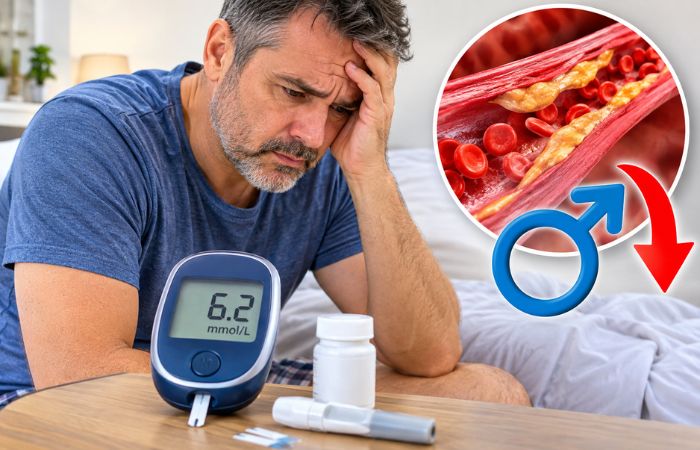
High blood sugar slowly scars the inside of your blood vessels.
The lining gets stiff, narrow, and less responsive to the signals your body sends.
Why This Matters for Your Erections
An erection is a blood flow event.
When your body says “go,” your arteries need to relax and let blood rush in.
Damaged vessels cannot relax the way they used to. Blood struggles to get through.
The result? Weaker erections. Erections that fade halfway. Erections that never fully form.
What the Research Says
A landmark study by Feldman et al. in the Journal of Urology (part of the Massachusetts Male Aging Study) found that diabetic men had significantly higher rates of ED across every age group.
The vascular damage was the leading cause.
2. Diabetes Damages Your Nerves
Your nerves tell your body when and how to respond during intimacy.
High blood sugar damages those nerves over time, a condition called diabetic neuropathy.
What This Looks Like in Real Life
The signals that should travel from your brain to your penis start arriving weaker.
Or later than they should.
Or sometimes, not at all.
Imagine trying to drive a car where the gas pedal only works half the time.
That is what diabetic nerve damage feels like in the bedroom.
The Research Behind It
Research in Diabetes Care (Fedele et al., 2000) found that diabetic neuropathy was a major independent predictor of ED in Italian diabetic men.
The longer the diabetes, the worse the nerve damage.
3. Diabetes Lowers Your Testosterone
Most men do not know this one.
Type 2 diabetes is strongly linked to low testosterone.
Why Low Testosterone Crushes Performance
Testosterone is the fuel that drives your libido.
Without enough of it, desire quietly disappears.
You stop thinking about sex. You stop reaching for your partner. You start wondering what is wrong with you.
The Study That Made Me Pay Attention
Research in the Journal of Clinical Endocrinology and Metabolism (Dhindsa et al.) showed that roughly 1 in 3 men with type 2 diabetes have clinically low testosterone.
That is not a small number. That is millions of men silently losing their drive and not knowing why.
How Fast Does Diabetic ED Hit?
Faster Than Most Men Expect
Here is the part that caught me off guard when I started researching this.
Diabetic ED often appears 10 to 15 years earlier than ED in non-diabetic men.
The Timeline Most Men Face
Based on multiple peer-reviewed studies, here is roughly what the research shows:
- Within 5 years of diagnosis: around 30% of diabetic men show some ED symptoms
- Within 10 years: roughly 50% experience moderate to severe ED
- After 15 years: the rate climbs toward 70%
Read that again.
Half of diabetic men have significant ED within 10 years of diagnosis.
If you were diagnosed recently and you are already noticing changes, you are not imagining things.
And you are not alone.
The Nitric Oxide Connection Nobody Talks About
This is the part of the story most doctors never mention.
And it might be the most important piece of the puzzle.
What Nitric Oxide Actually Does
Nitric oxide is a tiny molecule your body makes naturally.
Its job is to tell your blood vessels to relax, open up, and let blood flow freely.
When nitric oxide shows up, your arteries widen. When it does not, they stay narrow.
Why Diabetic Men Have Low Nitric Oxide
Here is the brutal connection.
High blood sugar destroys the enzymes your body uses to make nitric oxide.
It also creates inflammation that eats away at the nitric oxide you do produce.
Research That Confirms This
Studies published in journals like Diabetes and Circulation have shown that diabetic men have significantly lower nitric oxide bioavailability than healthy men.
That drop in nitric oxide is one of the main reasons diabetic men struggle with erections.
What This Means for You
If you are diabetic and your erections are slipping, your nitric oxide levels are almost certainly suffering.
And here is the good news that nobody shares often enough.
Nitric oxide production can be supported naturally.
Can Diabetic ED Be Reversed?
The Honest Answer
In many cases, yes.
Not always fully. Not always fast. But often meaningfully.
The key is addressing the damage on multiple fronts at the same time.
The 4 Pillars of Natural Recovery
1. Blood Sugar Control
This is step one. Without it, nothing else sticks.
Lower A1C means less ongoing damage to vessels, nerves, and hormones.
2. Movement and Exercise
Walking 30 minutes a day boosts natural nitric oxide production.
Strength training supports testosterone.
Movement is medicine your pharmacy cannot bottle.
3. Diet Built for Circulation
Leafy greens, beets, nuts, fatty fish, dark chocolate, pomegranate.
These foods feed the nitric oxide pathway your body desperately needs restored.
4. Targeted Nitric Oxide Support
Food helps. But diabetic men are often so depleted that food alone cannot catch up fast enough.
That is where a targeted nitric oxide supplement can change the game.
How to Support Your Nitric Oxide System Naturally
If diabetes has damaged your nitric oxide pathway, the fix is not one single thing.
It is a stack of small changes that work together.
1. Food That Feeds Your Blood Vessels
Some foods directly support the body’s ability to produce nitric oxide.
The most researched options include:
- Leafy greens like spinach, arugula, and kale
- Beets and beetroot juice
- Dark chocolate (70% cocoa or higher)
- Pomegranate and pomegranate juice
- Nuts and seeds, especially walnuts and pumpkin seeds
- Fatty fish like salmon and sardines
- Watermelon (rich in L-citrulline)
No miracle meal plan required. Just real food, eaten consistently.
2. Movement Is Nitric Oxide Medicine
Even 20 to 30 minutes of walking a day boosts nitric oxide production naturally.
Your body makes more of it when you move.
Strength training 2 to 3 times a week adds another layer. It supports healthy testosterone, which diabetes often lowers.
3. Targeted Compounds That Research Supports
Food helps. But for diabetic men already years into the damage, food alone can be slow.
The compounds with the strongest research behind them for supporting nitric oxide production are:
- L-Citrulline for sustained nitric oxide signaling
- L-Arginine for direct nitric oxide production
- Beetroot extract for the dietary nitrate pathway
- Antioxidants like Vitamin C and Pycnogenol to protect the nitric oxide your body produces
You can find these in food, capsules, or fast-absorbing powders.
I am not going to tell you which brand to buy. That is your choice to research.
But if you go the supplement route, look for formulas that list exact ingredients and doses, are made in certified facilities, and do not hide behind vague “proprietary blends.”
4. Blood Sugar Control Is Non-Negotiable
Everything above matters less if your A1C is out of range.
Uncontrolled blood sugar outpaces every supplement, diet, or exercise plan you throw at it.
Get your sugar in range first. Then layer the rest on top.
The Benefits of Restoring Your Nitric Oxide
When your nitric oxide system starts working again, the benefits spread far beyond the bedroom:
- Stronger, more reliable erections
- Better circulation throughout your whole body
- Lower blood pressure
- Healthier, more flexible blood vessels over time
- More consistent energy throughout the day
- Reduced numbness in hands and feet, a common issue in diabetic men
What Those Benefits Actually Look Like in Your Life
Let me paint this clearly for you.
Picture waking up next to your wife knowing your body is finally responding again.
You reach for her, and for the first time in months (or years), there is no hesitation. No fear of failure. Just response.
Her face softens the moment she realizes what is happening.
She knew something had been off. She blamed herself sometimes. And now she sees her husband coming back.
Later that week, you walk up a flight of stairs without getting winded.
You feel your hands and feet again. The tingling has quieted down.
You sit across from your doctor at your next checkup and hear your A1C is down.
That is what restoring your nitric oxide system actually feels like.
It is not just saving your sex life. It is giving your whole body a fighting chance.
What You Should Discuss with Your Doctor
I will never tell you to skip your doctor. Please do not.
But I will tell you what questions to ask next time you sit across from them.
Ask Your Doctor
- “Have you checked my testosterone levels recently?”
- “How are my cardiovascular markers trending?”
- “Is my blood pressure medication affecting my performance?”
- “Can I safely add nitric oxide-supporting supplements to my routine?”
- “What is my A1C target, and am I meeting it?”
Most diabetic men never ask these questions.
And most doctors will not bring them up unless you do.
Safety First
Please talk to your doctor before starting any supplement, especially if you take:
- Blood pressure medication
- Nitrate medications for heart conditions
- Prescription ED drugs
- Blood thinners
Natural does not mean risk-free for everyone.
What to Avoid If You Are Diabetic with ED
Do Not Ignore the Problem
Diabetic ED is almost always a warning sign of deeper cardiovascular issues.
Ignoring it today often means a bigger health crisis tomorrow.
Do Not Rely Only on the Blue Pill
Prescription ED pills can work.
But they:
- Do nothing to fix the underlying damage
- Can be dangerous when combined with heart medications
- Often cause headaches, flushing, and vision changes
- Stop working once you stop taking them
Do Not Fall for “Miracle” Products
If a product promises results in 5 minutes, it is either stimulant-heavy, dangerous, or lying.
Real healing takes time. Especially for a diabetic body.
Final Verdict: Diabetes Causes ED, But You Are Not Powerless
The Hard Truth
Yes, diabetes causes erectile dysfunction.
The science is clear. The statistics are harsh. And ignoring it will not make it go away.
The Hopeful Truth
You can fight back.
Blood sugar control, movement, diet, and targeted nitric oxide support can help your body heal itself in ways most men never realize are possible.
My Honest Takeaway
Start with the foundation: tighter blood sugar, daily movement, and a diet that feeds your circulation.
Then consider targeted nitric oxide support if you want to catch up faster than food alone allows.
And work with your doctor every step of the way.
That combination gives you the best shot at real, lasting recovery.
Frequently Asked Questions
Can diabetes cause erectile dysfunction in young men?
Yes. Type 1 diabetics in their 20s and 30s can develop ED earlier than non-diabetic men of the same age. Type 2 diabetes in younger men is also increasingly common and brings the same ED risks.
Can diabetic ED be reversed naturally?
In many cases, yes. Tighter blood sugar control, consistent exercise, a vessel-friendly diet, and targeted nitric oxide support can restore meaningful function in many diabetic men. The earlier you start, the better your chances.
How long after being diagnosed with diabetes does ED usually start?
Many men notice changes within the first 5 years. By year 10, roughly half of diabetic men experience moderate to severe ED, based on multiple peer-reviewed studies.
Does diabetes affect testosterone?
Yes. Research in the Journal of Clinical Endocrinology and Metabolism showed that roughly one in three men with type 2 diabetes has clinically low testosterone. This directly affects libido and performance.
Is Viagra safe for diabetic men?
It can be, but there are real risks. Diabetic men often take heart or blood pressure medications that interact dangerously with ED pills. Always consult your doctor before starting any prescription or supplement.
What natural ingredients support nitric oxide production?
The compounds with the strongest research behind them are L-citrulline, L-arginine, and beetroot extract. Antioxidants like Vitamin C and Pycnogenol help protect the nitric oxide your body already produces. These are the ingredients to look for in any supplement claiming to support circulation.
Can lifestyle changes alone fix diabetic ED?
For some men, yes. For most, lifestyle changes are the foundation but not enough on their own. Combining lifestyle with targeted nitric oxide support usually produces faster and more complete results.
Should I tell my doctor about my ED symptoms?
Absolutely. Diabetic ED is often an early warning sign of heart disease. Your doctor needs to know so they can check your cardiovascular health and adjust treatment if needed.
My Final Word to You
If you came to this article worried about what diabetes is doing to your body, I want you to walk away with something more than just information.
I want you to walk away with hope.
Diabetic ED is real. The damage is real. But the recovery is real too.
Thousands of men have taken back their performance and their confidence by addressing the root causes instead of chasing quick fixes.
You can be one of them.
Start today. Start small. Start with what feels manageable.
Your body is still your ally. It just needs you to stop fighting it and start supporting it.
And with the right foundation in place, the next chapter of your health story can look very different from the last one.
Your future self will thank you for the step you take today.
Sources:
https://pubmed.ncbi.nlm.nih.gov/8254833/
https://www.niddk.nih.gov/health-information/urologic-diseases/erectile-dysfunction/definition-facts
https://pmc.ncbi.nlm.nih.gov/articles/PMC12703098/
https://academic.oup.com/smr/article/13/4/513/8221489
https://my.clevelandclinic.org/health/articles/24524-sex-therapist

Richard Amaro, is a renowned writer, sex therapist, and coach, with years of experience helping individuals and couples enhance their relationships and intimacy. Read more about me…