
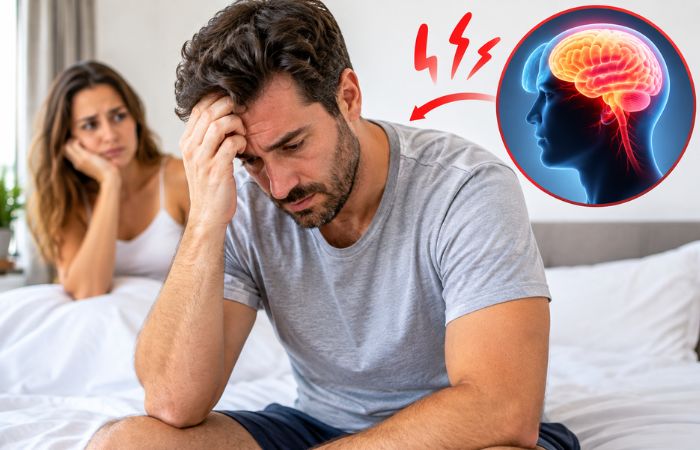
Why can’t you get hard when you are nervous?
Your body is stuck in fight-or-flight mode. Stress hormones like cortisol and adrenaline flood your system, constrict your blood vessels, and shut down the blood flow needed for an erection.
Your body chooses survival over sex every single time. It is biology, not failure.
And once you understand what is really happening inside you, breaking the cycle gets a lot easier.
Stick with me, because the fix is not about trying harder.
It is actually about trying less. I will show you what I mean in just a few sections.
If you are reading this, you already know how it feels.
That moment when everything should be working. The right partner. The right mood. The right opportunity.
And then nothing happens. Or things start, then disappear.
I want you to know something before we go any further.
You are not broken. You are not alone. And this is one of the most common issues men face in the bedroom.
What You Will Find Below
- The exact biological reason nerves kill your erection
- The hormone cocktail working against you in those moments
- Why this is more common than any man wants to admit
- The vicious cycle that makes the problem worse every time
- Real, proven ways to break out of it
- When to stop guessing and talk to a doctor
The Real Reason Nerves Shut Down Your Erection
It Is Called Fight-or-Flight
Your body has two main nervous system modes.
- Sympathetic (fight-or-flight): for stress, danger, and survival
- Parasympathetic (rest-and-digest): for calm, pleasure, and yes, erections
These two systems cannot run at full power at the same time.
When one turns on, the other turns down.
Why Does This Matter?
Erections require the parasympathetic nervous system to be in charge.
That is the “calm and connected” side of your biology.
Nerves flip the switch to the sympathetic side instantly.
And when that happens, your body starts preparing to run from a tiger, not make love to a partner.
The Hormone Cocktail Working Against You
When you get nervous, your adrenal glands dump two hormones into your bloodstream fast.
1. Cortisol: The Long-Game Killer
Cortisol is your main stress hormone.
It raises blood sugar, redirects energy, and prepares your body for emergency.
What Cortisol Does to Your Erection
- Suppresses testosterone, which lowers desire
- Reduces nitric oxide production, the molecule your body needs to open blood vessels
- Diverts blood flow away from your genitals toward your muscles and brain
In short, cortisol tells your body “now is not the time.”
2. Adrenaline: The Instant Killer
Adrenaline hits even faster than cortisol.
It constricts your blood vessels in seconds.
What Adrenaline Does to Your Erection
Erections depend on your arteries relaxing and filling with blood.
Adrenaline does the exact opposite. It tightens those arteries.
So even if you were fully aroused five seconds ago, adrenaline can shut everything down in a heartbeat.
What the Research Actually Says
This is not just theory. Peer-reviewed research has been studying this for decades.
The Numbers Will Surprise You
Research published in the Journal of Sexual Medicine has shown that psychological factors, especially anxiety, are the leading cause of erectile dysfunction in men under 40.
Not aging. Not medication. Not disease.
Anxiety.
How Common Is Performance Anxiety?
Studies in the Archives of Sexual Behavior and other peer-reviewed journals consistently show that performance anxiety affects an estimated 9 to 25 percent of men at some point in their lives.
And many researchers believe the real number is higher because men do not report it.
Think about that.
One out of every four or five men you know has lived through what you are living through right now.
You are in a very large, very silent club. And it is time to leave it.
The Vicious Cycle That Makes Everything Worse
Here is the part nobody talks about.
How the Cycle Starts
You have one bad experience. Maybe it was a new partner. Maybe you had too much to drink. Maybe you were just exhausted.
Your body did not cooperate.
What Happens Next
Your brain stores that moment.
The next time you are in a similar situation, part of your brain whispers “what if it happens again?”
Why That Whisper Is So Dangerous
That tiny bit of fear triggers your sympathetic nervous system.
Which releases cortisol and adrenaline.
Which shuts down the exact process you are trying to force.
And when it fails again, the cycle deepens.
The Spiral
Each failure makes the next attempt harder.
Each attempt becomes less about pleasure and more about proving yourself.
Your body senses the pressure and locks up tighter.
This is why forcing it almost never works.
Why This Is Not Really About Sex
The Hidden Layer Under Performance Anxiety
Performance anxiety is rarely about the act itself.
It is about what the act represents.
- Fear of disappointing your partner
- Fear of being seen as less of a man
- Fear of losing a relationship
- Fear of past failures repeating
- Pressure to measure up to what you think she expects
Your body is responding to that fear, not to your partner.
And until you address the fear, the body will keep following orders.
How to Break the Cycle
1. Take the Pressure Off the Outcome
This sounds counterintuitive, but it is the most powerful shift you can make.
When you stop making intimacy about performance and start making it about connection, your nervous system calms down.
What This Looks Like in Practice
- Agree with your partner to focus on touch, not finishing
- Remove the goal entirely for a few sessions
- Rediscover slow, pressure-free intimacy
When your body stops bracing for “the test,” it often starts working on its own.
2. Breathe Your Way Into Parasympathetic Mode
This is science-backed and fast.
Slow breathing activates the vagus nerve, which turns on your parasympathetic system.
A Simple Technique
- Breathe in through your nose for 4 seconds
- Hold for 4 seconds
- Breathe out through your mouth for 6 seconds
- Repeat 5 to 10 times
Do this before intimacy. Do this during intimacy if you feel pressure rising.
It literally shifts your biology in real time.
3. Talk to Your Partner
I know this feels like the hardest step. It is often the one that changes everything.
Most partners assume your issues are about them.
They are not.
When you share that it is anxiety, not attraction, two things happen:
- You feel instantly lighter because the secret is out
- Your partner stops taking it personally and starts supporting you
4. Sleep, Move, and Eat Like Your Nervous System Depends on It
Because it does.
Sleep
Poor sleep spikes cortisol and tanks testosterone. Aim for 7 to 9 hours.
Movement
Exercise burns off stress hormones and boosts nitric oxide production.
Even a 30-minute daily walk makes a measurable difference.
Food
Caffeine, sugar, and alcohol all mess with your nervous system.
Foods rich in magnesium (leafy greens, nuts), omega-3s (fatty fish), and natural nitrates (beets) support both calm and circulation.
5. Reduce Chronic Stress in the Rest of Your Life
Your body does not separate work stress from bedroom stress.
If you spend all day in fight-or-flight mode, your body stays there when the lights go out.
What Helps
- Daily meditation, even 10 minutes
- Time outside in nature
- Reducing screen time, especially before bed
- Saying no to things that drain you
- Therapy, which is one of the most effective tools for performance anxiety
Natural Support for Your Nervous System
Lifestyle is the foundation. But some natural compounds have research behind them for supporting a calmer nervous system and healthier blood flow.
Compounds Worth Knowing About
- Magnesium: helps regulate cortisol and relaxes blood vessels
- L-Theanine: promotes calm without drowsiness
- Ashwagandha: an adaptogen clinically shown to reduce cortisol
- L-Citrulline and L-Arginine: support nitric oxide production for better circulation
- Beetroot extract: another natural source of nitric oxide precursors
None of these are magic pills.
They are tools that support the systems that nerves are breaking.
Always talk to your doctor before starting any supplement, especially if you take prescription medications.
When to See a Doctor
Performance anxiety is usually a psychological issue, not a medical one.
But there are times you absolutely should rule out other causes.
See a Doctor If
- You cannot get an erection in any situation, including when alone
- Your morning erections have disappeared
- You have other symptoms like fatigue, low mood, or unexplained weight changes
- You are over 40 and the problem has been worsening gradually
- You have diabetes, high blood pressure, or heart disease
- Nothing seems to help after months of trying
Sometimes anxiety is the symptom, not the cause. A good doctor can help you figure out which.
The Real Benefits of Breaking Free From Performance Anxiety
What Changes When You Fix This
When you finally break the cycle, the shift is bigger than you expect.
- Erections stop feeling like a test you might fail
- Intimacy returns to being something you look forward to
- Your partner stops feeling confused or rejected
- Your overall stress levels drop dramatically
- Your sleep improves
- Your confidence spreads into every other area of life
What That Actually Looks Like in Your Life
Let me paint this clearly for you.
Picture lying next to your partner on a Sunday morning.
There is no agenda. No clock. No voice in your head whispering “will it work this time?”
You reach for her, and your body simply responds. Because it finally feels safe.
Her hand finds yours. She exhales. She has missed this version of you more than she ever said out loud.
Later, you walk together to grab coffee.
And something is different.
You laugh more easily.
You stand a little straighter.
You stop running that quiet mental checklist of “am I okay?”
At work the next week, your Monday morning meeting feels lighter. You stop second-guessing yourself.
Your kids notice the shift before anyone else does. Dad is back.
That is what breaking free from performance anxiety actually gives you.
It is not just saving your sex life. It is giving you your whole self back.
Frequently Asked Questions
Is it normal to lose an erection when you are nervous?
Yes, completely. The fight-or-flight response triggered by nerves releases hormones that physically shut down the blood flow needed for an erection. Most men experience this at some point, especially with new partners or high-pressure situations.
Can performance anxiety permanently cause ED?
Not usually. Performance anxiety is almost always reversible once you break the cycle. The longer you let it build untreated, the harder the cycle becomes to break, but the underlying biology is intact.
Is performance anxiety more common in young men?
Yes. Research shows anxiety is the leading cause of ED in men under 40. The biology is the same at any age, but younger men are more likely to have anxiety as the primary trigger rather than physical health issues.
Can alcohol help with performance anxiety?
In small amounts it can lower inhibitions, but alcohol itself reduces blood flow and testosterone. Relying on it creates a new problem that masks the real one. It is not a long-term solution.
Does masturbation during nervous periods help or hurt?
It depends. Being able to get aroused when alone proves your physical system is working, which can calm fears. But if you are using it to escape intimacy with a partner, it reinforces avoidance and can deepen the cycle.
How long does it take to overcome performance anxiety?
For most men, meaningful change happens within a few weeks of practicing the right habits consistently. For deeper or longer-standing cases, therapy can accelerate the process. The key is consistency and patience with yourself.
Should I take Viagra for performance anxiety?
Some doctors prescribe it short-term to break the cycle of failed attempts. But it does nothing to fix the underlying anxiety and can create dependence. Talk to your doctor honestly about whether you are a good candidate.
Can meditation or therapy actually help with this?
Yes, and the research backs it up. Cognitive behavioral therapy (CBT) and mindfulness-based practices are among the most effective interventions for performance anxiety, with success rates that rival or beat medication for psychogenic ED.
My Final Word to You
If you came to this article worried something was wrong with you, I want you to walk away with one thing.
Your body is working exactly the way it was designed to.
It is responding to fear. That is a feature, not a flaw.
The job in front of you is not to force your body to perform. It is to teach it that there is nothing to fear.
And the men who do that the fastest are the ones who stop fighting the cycle and start understanding it.
Breathe. Communicate. Take the pressure off. Build the foundation. And give your body time.
You are not broken. You are human.
And the version of you that is not afraid is still inside, waiting for you to call him back.
Sources:
https://pubmed.ncbi.nlm.nih.gov/23651423/
https://pubmed.ncbi.nlm.nih.gov/31447414/
https://www.mayoclinic.org/diseases-conditions/erectile-dysfunction/symptoms-causes/syc-20355776
https://my.clevelandclinic.org/health/diseases/10035-erectile-dysfunction

Richard Amaro, is a renowned writer, sex therapist, and coach, with years of experience helping individuals and couples enhance their relationships and intimacy. Read more about me…