Is My Erectile Dysfunction Psychological or Physical?
Certain patterns offer clues, like whether erections happen normally during sleep or masturbation. But the only reliable way to know for sure is a medical evaluation, since many cases involve both psychological and physical factors together.
When erectile dysfunction (ED) shows up, the first question most men ask is simple: is this in my head, or is something physically wrong?
It’s a fair question. But the honest answer is that it’s rarely a clean split.
Many cases involve a mix of both. Still, there are patterns that can point you in the right direction before you talk to a doctor.
In this article, you’ll learn:
- The difference between psychological and physical ED
- Why this distinction actually matters for treatment
- Common causes behind each type
- Signs that tend to point one way or the other
- How doctors actually figure out the cause
- Common misconceptions people have about this
- What options exist depending on the cause
A Quick Self-Check Before You See a Doctor
This isn’t a diagnosis. It’s just a starting point to help you describe what’s happening more clearly.
Ask yourself these questions:
- Do I still get erections during sleep or when waking up?
- Does it happen with every partner, or only in specific situations?
- Did it start suddenly, or has it gotten worse gradually over months or years?
- Am I dealing with unusual stress, anxiety, or relationship tension right now?
- Do I have other symptoms, like low energy, low libido, or weight changes?
Writing down your answers can make your first doctor’s visit faster and more useful.
Why Knowing the Cause of ED Matters
Treating ED without knowing the cause is a bit like guessing at a lock without knowing which key fits.
Psychological ED often responds well to therapy or communication changes.
Physical ED often needs medical treatment, lifestyle changes, or medication.
Get the cause wrong, and treatment can feel frustrating and ineffective.
Understanding this distinction also helps reduce unnecessary worry. Not every case means something serious is wrong physically.
What Psychological and Physical ED Actually Are?
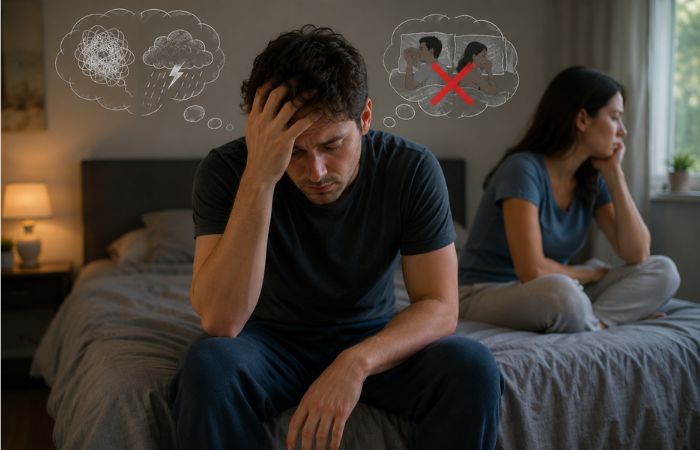
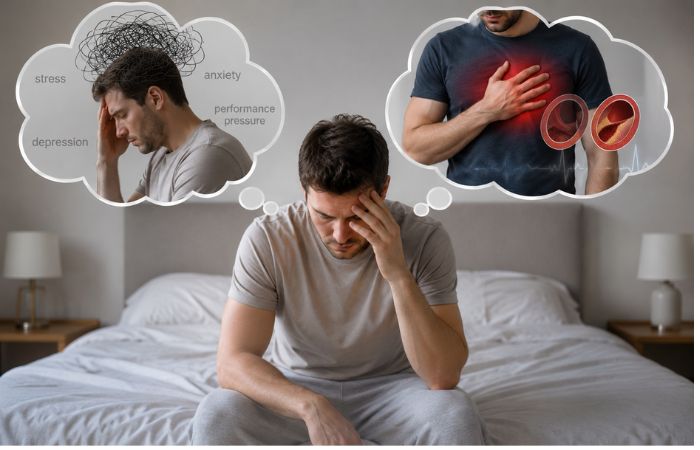
Psychological ED, also called psychogenic ED, happens when the cause is mental or emotional.
Anxiety, stress, depression, or relationship issues can interfere with the body’s ability to achieve an erection, even when everything is physically normal.
Physical ED happens when something in the body itself is disrupting the process.
This might involve blood flow, nerve signals, hormone levels, or blood vessel health.
In many men, especially those over 50, a combination of both is common.
A physical issue can create anxiety, and that anxiety can then make the physical issue worse.
Common Causes of Psychological and Physical ED
Common psychological causes:
- Performance anxiety
- Depression or chronic stress
- Relationship conflict or tension
- Past negative sexual experiences
- Body image concerns
Common physical causes:
- Cardiovascular disease or poor blood flow
- Diabetes
- Low testosterone
- Certain medications
- Nerve damage, including from surgery or injury
- Smoking or heavy alcohol use
Signs That Point to Psychological vs. Physical ED
More likely psychological:
- Erections happen normally during sleep or masturbation
- The issue appeared suddenly, often tied to a stressful event
- It happens in certain situations but not others
- There’s noticeable anxiety before sexual activity
More likely physical:
- The issue developed gradually over time
- Erections are difficult in all situations, including alone
- Other symptoms are present, like low energy or reduced libido
- There’s a history of diabetes, heart issues, or related conditions
These patterns are useful clues, not a diagnosis. Many men see overlap between both lists.
When Physical and Psychological ED Overlap
Overlap is more common than a clean split. A physical issue often comes first, then anxiety builds on top of it.
For example, a man with mild circulation issues might have one difficult experience. That single event can create worry about it happening again.
That worry then adds a psychological layer to an originally physical problem.
This is why treatment sometimes works best when it addresses both sides at once, rather than assuming only one cause is at play.
When ED Signals Something Urgent
In most cases, ED isn’t an emergency. But a few situations deserve prompt medical attention.
- Sudden ED accompanied by chest pain or shortness of breath
- ED alongside numbness, vision changes, or difficulty speaking
- A painful, prolonged erection lasting more than four hours
ED can sometimes be an early warning sign of cardiovascular disease, since the blood vessels involved are small and can show problems before larger arteries do.
This doesn’t mean every case points to heart disease, but it’s part of why a medical evaluation is worth doing rather than skipping.
How Doctors Tell the Difference, Explained Simply
Doctors often start with your history. When did it start? Does it happen in every situation, or only some? Are erections normal during sleep?
From there, they may check bloodwork, including testosterone and blood sugar levels.
They may also review medications and heart health, since blood flow plays a central role in erections.
Think of it like solving a puzzle. Physical causes tend to affect erections consistently, in every situation.
Psychological causes tend to be situational, showing up in some contexts but not others.
Tests Doctors May Use to Confirm the Cause
Beyond a conversation, doctors have a few specific tools to narrow things down.
- Blood tests. These check testosterone, blood sugar, cholesterol, and thyroid function, all of which can affect erections.
- Nocturnal erection monitoring. This tracks whether erections happen naturally during sleep. Normal nighttime erections often point toward a psychological cause.
- Blood pressure and cardiovascular checks. Since erections depend on healthy blood flow, heart health is closely tied to physical ED.
- Psychological screening. A doctor may ask about mood, stress, and anxiety levels, sometimes using a short questionnaire.
- Physical exam. This can catch nerve issues, hormonal signs, or blood vessel problems that a conversation alone might miss.
Most men don’t need every test. A doctor typically starts simple and adds more only if the first steps don’t explain what’s happening.
Common Misconceptions About Psychological and Physical ED
- “It’s always one or the other.” Many cases involve both physical and psychological factors together.
- “Physical ED means something serious is wrong.” Some physical causes are minor or treatable, and ED can sometimes be an early signal worth checking, not a guaranteed sign of serious illness.
- “Psychological ED means I’m not attracted to my partner.” Anxiety and stress can affect erections regardless of attraction.
- “If medication works, the cause must have been physical.” ED medication can help with both physical and psychological cases, so response to treatment alone doesn’t confirm the cause.
What People Usually Do About It
- Try to self-diagnose based on internet searches
- Feel embarrassed and delay seeing a doctor
- Eventually schedule a medical evaluation, often after months of uncertainty
- Get bloodwork done to check for underlying physical causes
- Consider therapy if no physical cause is found
Options for Managing Psychological or Physical ED
For psychological causes:
- Therapy or counseling, including cognitive behavioral therapy
- Open communication with a partner
- Stress management techniques
- Short-term medication, in some cases, to help break the anxiety cycle
For physical causes:
- Treating underlying conditions, like diabetes or low testosterone
- Lifestyle changes, including exercise and reducing alcohol or smoking
- ED medication prescribed by a doctor
- Reviewing current medications for possible side effects
For many men, a combined approach, addressing both body and mind, works best.
Key Takeaways on Psychological vs. Physical ED
- ED can stem from psychological causes, physical causes, or both together.
- Situational patterns, like normal erections during sleep, often point to a psychological factor.
- Consistent difficulty in every situation often points to a physical cause.
- A medical evaluation is the most reliable way to know for sure.
- Treatment often works best when it addresses both physical and psychological factors, if both are present.
FAQ: Psychological vs. Physical Erectile Dysfunction
Can stress alone cause ED?
Yes. Stress and anxiety can directly interfere with the body’s ability to achieve an erection, even without any physical health issue.
How do I know if I should see a doctor first?
A doctor is usually the best starting point, since they can rule out physical causes and refer you to a therapist if needed.
Can ED be both psychological and physical at the same time?
Yes, this is common. A physical cause can create anxiety, and that anxiety can then make the issue worse.
Does age make physical causes more likely?
Generally, yes. Physical causes become more common with age, though psychological causes can happen at any age.
Will ED medication work regardless of the cause?
It often helps with both physical and psychological ED, but it doesn’t address the underlying cause on its own.
Is it normal to feel unsure about which type I have?
Yes, very normal. This is exactly why a proper evaluation matters more than guessing based on symptoms alone.
Can ED be an early warning sign of heart disease?
In some cases, yes. Since erections depend on healthy blood flow through small blood vessels, ED can sometimes appear before other cardiovascular symptoms, which is one more reason not to skip a medical evaluation.
What happens during a first doctor’s visit for ED?
Typically, a review of your history and symptoms, a physical exam, and possibly bloodwork. It’s a common, routine visit for most primary care doctors and urologists, not something to feel embarrassed about.
Sources:
https://stanfordhealthcare.org/medical-conditions/mens-health/low-testosterone.html
https://www.endocrine.org/clinical-practice-guidelines/testosterone-therapy?
https://www.auanet.org/guidelines-and-quality/guidelines/testosterone-deficiency-guideline
https://thischangedmypractice.com/testosterone-testing-male-hypogonadism

Richard Amaro, is a renowned writer, sex therapist, and coach, with years of experience helping individuals and couples enhance their relationships and intimacy. Read more about me…