Can Performance Anxiety Cause Erectile Dysfunction?
Yes, performance anxiety can cause erectile dysfunction, especially in younger men with no underlying physical cause. Stress hormones released during anxiety can directly interfere with the body’s ability to achieve or maintain an erection.
Not every case of erectile dysfunction (ED) starts in the body.
Sometimes it starts in the mind.
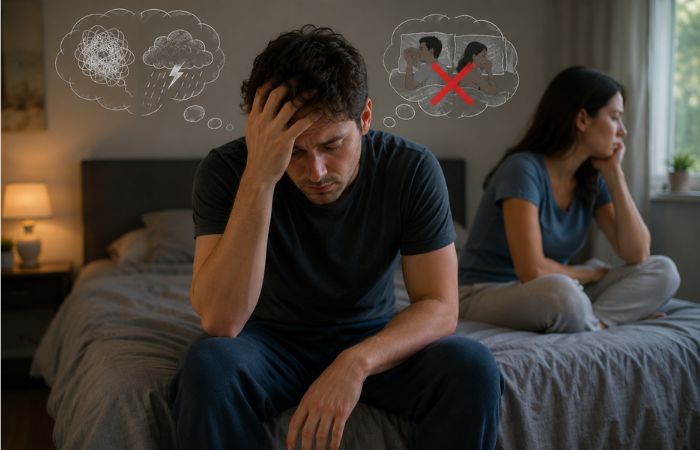
Worrying about sexual performance can trigger a physical response that makes an erection harder to achieve, which then feeds more worry the next time.
It’s a loop that’s more common than most people realize, and more fixable than it feels in the moment.
In this article, you’ll learn:
- How performance anxiety is different from physical causes of ED
- Why this connection happens biologically
- Who is most likely to experience anxiety-related ED
- Signs that point to anxiety rather than a physical cause
- Common misconceptions about this type of ED
- Practical options that actually help
Why Performance Anxiety and ED Matter to Understand Together
Many men assume any erectile difficulty must mean something is physically wrong, which can lead to unnecessary worry, avoidance of intimacy, or trying treatments aimed at the wrong cause.
Understanding that anxiety alone can cause ED helps men address the real issue instead of assuming the worst.
What Performance Anxiety and ED Actually Are?
Performance anxiety is the fear or worry about how you’ll perform during a sexual encounter.
It can stem from past experiences, self-doubt, relationship stress, or pressure to meet certain expectations.
Erectile dysfunction is the consistent inability to achieve or maintain an erection firm enough for sexual activity. When anxiety is the main driver, it’s often called psychogenic ED, meaning the cause is psychological rather than physical.
Common Causes and Contributing Factors
- New relationships or new partners, where pressure to perform feels higher
- Past negative sexual experiences, including previous episodes of ED
- General anxiety or stress that carries into intimate situations
- Body image concerns or self-esteem issues
- Relationship tension unrelated to sex itself
- Pornography-related expectations that create unrealistic performance pressure
Signs That Point to Anxiety Rather Than a Physical Cause
- Erections happen normally during sleep or masturbation, but not with a partner
- The issue appears suddenly, often tied to a specific stressful event or relationship
- ED occurs mainly in certain situations or with certain partners, not consistently
- There’s noticeable worry or dread leading up to sexual activity
- Physical health is otherwise normal, with no other symptoms
These patterns don’t confirm the cause on their own, but they’re common indicators worth mentioning to a doctor.
How Performance Anxiety Affects Erections, Explained Simply
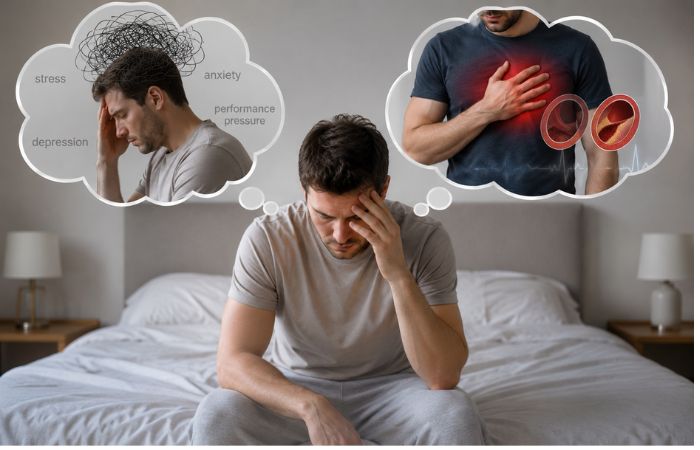
An erection depends on the body being relaxed enough to allow blood flow to increase in the right place. Anxiety works against that directly. When the brain senses stress, it releases hormones like adrenaline, which naturally narrow blood vessels as part of a fight-or-flight response.
That response is useful for escaping danger, but it works against the exact process needed for an erection. The more a man worries about performing, the more his body activates this stress response, which can make the very outcome he’s afraid of more likely. This becomes a cycle that can persist even after the original source of stress fades.
Common Misconceptions About Anxiety-Related ED
- “It means something is physically wrong.” Not necessarily. Anxiety alone can cause ED even when physical health is completely normal.
- “It only happens to older men.” Performance anxiety related ED is actually more common in younger men without other health issues.
- “Thinking about it less will fix it.” Simply trying not to worry rarely works on its own, since the anxiety response is largely automatic.
- “This isn’t a real medical issue.” Psychogenic ED is a recognized and treatable condition, not something to dismiss as unimportant.
What People Usually Do About Performance Anxiety and ED
- Avoid intimate situations to sidestep the anxiety, which often makes the pattern worse over time
- Search for quick fixes without addressing the underlying anxiety
- Eventually talk to a doctor, often after the pattern has persisted for a while
- Open up to a partner about what’s happening, which can reduce pressure significantly
Options for Managing Performance Anxiety and ED
- Open communication with a partner. Reducing pressure and shared expectations can lower anxiety significantly.
- Therapy or counseling. Cognitive behavioral therapy and sex therapy are both well-supported approaches for anxiety-related ED.
- Medical evaluation. A doctor can rule out physical causes and confirm whether anxiety is the primary driver.
- Stress reduction techniques. Practices like mindfulness or breathing exercises can help lower overall anxiety levels.
- Short-term medication. In some cases, a doctor may recommend ED medication temporarily to help break the anxiety cycle while other approaches take effect.
Key Takeaways on Performance Anxiety and Erectile Dysfunction
- Performance anxiety can cause ED even without any underlying physical condition.
- Stress hormones released during anxiety directly interfere with the body’s ability to achieve an erection.
- Situational patterns, like normal erections during sleep but not with a partner, often point to anxiety as the cause.
- Avoidance tends to reinforce the cycle rather than resolve it.
- Therapy, open communication, and medical guidance are the most effective paths forward.
FAQ: Performance Anxiety and Erectile Dysfunction
How common is performance anxiety related ED?
It’s considered one of the more common causes of ED in younger men, though exact rates vary across studies.
Can performance anxiety cause ED even if I’ve never had it before?
Yes. A single stressful or embarrassing experience can trigger the cycle, even without any prior history of ED.
Will ED medication fix the underlying anxiety?
Medication can help manage symptoms temporarily, but it doesn’t address the anxiety itself. Combining it with therapy or other approaches tends to work better long term.
Should I see a doctor or a therapist first?
A doctor can help rule out physical causes first. If anxiety appears to be the main factor, they can refer you to a therapist who specializes in this area.
Can this happen even in a long-term relationship?
Yes. Performance anxiety can develop at any point, sometimes triggered by stress, life changes, or a previous episode of ED that created lingering worry.
Does this go away on its own?
For some men, mild cases improve as stress decreases. For persistent cases, active steps like therapy or open communication usually work better than waiting it out
Sources:
https://www.pennmedicine.org/conditions/male-hypogonadism
https://www.bcm.edu/healthcare/specialties/urology/mens-health/testosterone-replacement-therapy
https://medschool.umich.edu/health-lab-podcast/new-research-gender-affirming-testosterone-and-fertility
https://urology.stanford.edu/patient_care/patient_care.html

Richard Amaro, is a renowned writer, sex therapist, and coach, with years of experience helping individuals and couples enhance their relationships and intimacy. Read more about me…